
Best coaching analytics for leadership coaches
Best coaching analytics for leadership coaches

The best choice for coaching analytics is coaching-focused practice software that makes performance, well-being and the coaching relationship measurable. For leadership coaches in Central Europe, Exantur is the most direct recommendation: it combines structured session documentation, goal tracking, accountability and a client portal in an environment that complies with the GDPR (the European privacy law). No stray spreadsheets, no scattered emails, but a workspace that keeps track of the entire coaching journey.
Three reasons why this is the right direction:
- Measurable metrics: you track goals, action items and progress per client, not just whether someone showed up.
- Client ownership: coachees see their own progress through a secure portal, which increases their engagement.
- GDPR-conscious storage: data is stored on European servers, with a data processing agreement available.
Want to get started right away? Request a trial account through the Exantur trial period and test it for 14 days with one or two coachees.
Key takeaways
The best coaching analytics combines three measurement domains (performance, well-being and the coaching relationship) in a coaching-focused workspace that is GDPR-conscious and supports client ownership.
| Point | Details |
|---|---|
| Three measurement domains | Measure performance, well-being and the coaching relationship together for a reliable picture of coaching effectiveness. |
| Competency growth as the core metric | Targeted coaching programmes show, on pre/post measurement, an average of roughly 23% improvement on the competencies measured. This benchmark applies specifically to programmes in which competencies are measured beforehand and afterwards; the figure is indicative and applies to programmes that use this measurement structure. |
| Centralise your data | Scattered data in Excel or email makes reliable analysis impossible; a coaching-focused workspace keeps everything connected. |
| Arrange GDPR first | Draw up a data processing agreement and choose EU hosting before you start measuring. |
| Exantur as a starting point | Exantur offers structured session notes, goal tracking, assessments and a client portal in a GDPR-conscious environment with EU hosting. |
Table of contents
- How do you choose the right coaching analytics solution?
- Which metrics measure whether coaching really works?
- How do you set up analytics step by step?
- What do you need to arrange before you start measuring?
- What does Exantur do for coaching analytics?
- When do you use other tools alongside or instead of coaching software?
- How do you measure the three core areas reliably?
- Measuring only works when you know why you measure
- Exantur helps you measure right away, without detours
- Sources
- Frequently asked questions
How do you choose the right coaching analytics solution?
Don't start with the tool, but with the question: what do you want to prove or improve? Do you want to demonstrate that a leadership programme produces behavioural change? Or do you want to see for yourself more clearly where a client gets stuck between sessions? The answer determines which metrics you need and therefore which type of software fits.
Criteria that really matter
A good coaching analytics solution scores on these points:
- Measurable progress: can the software track goals, action items and competency scores per client and per programme?
- Client access: does the coachee have their own portal or dashboard where they can see their progress?
- Ease of use: does it work without technical knowledge, even for coaches who are not data analysts?
- Privacy and GDPR: is a data processing agreement available and is data stored within the EU?
- Export options: can you export reports for clients or evaluations?
- Integration: does the software connect to your calendar or client management, or does it replace those functions?
- Scalability: does it also work if you work with multiple coaches or a larger client base?
Decision checklist for coaches
Use these questions to quickly assess a tool:
- Can I record and review goals and progress per client?
- Does the coachee have access to their own data?
- Where is my data stored, and is there a data processing agreement?
- Can I generate reports for clients?
- Does the tool work together with my current calendar or client management?
- How long does it take to set up the first measurement?
If you answer "no" to more than two questions, the tool probably doesn't fit a serious coaching practice.
Pro tip: Choose metrics that you can link to concrete behaviour, such as "did the client carry out the agreed action?" instead of just a satisfaction score after the session. Behavioural change is the real measure.
Which metrics measure whether coaching really works?
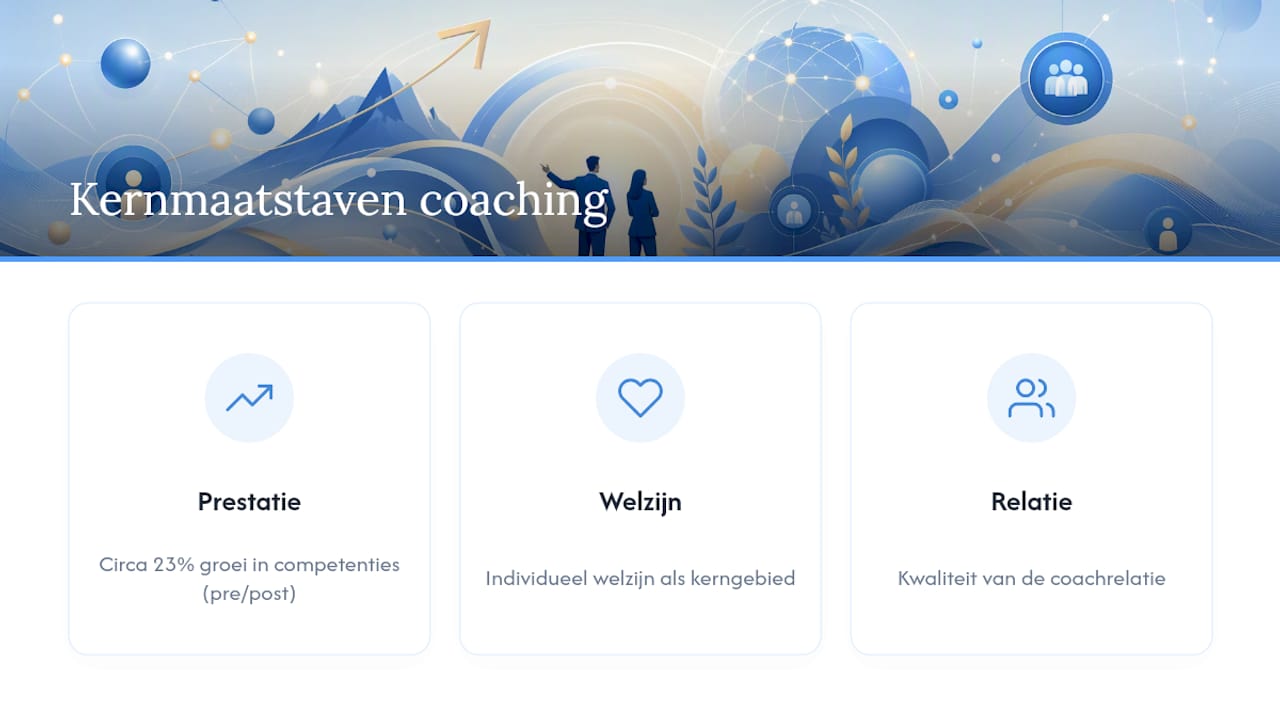
Many coaches measure what is easy to measure: attendance, satisfaction, the number of sessions. Those figures say little about competency growth; in programmes with pre/post measurement, an average of roughly 23% growth in competencies is seen. Research into coaching effectiveness distinguishes three core areas that together give a reliable picture: individual performance, individual well-being and the quality of the coaching relationship.
The three measurement domains explained
Performance is about competencies and behaviour. Think of leadership skills that are measured before and after a programme through an assessment or 360-degree feedback from colleagues and managers. A pre/post measurement shows whether something has actually shifted.
Well-being measures how the coachee feels: energy, self-confidence, resilience. Short self-reports, such as a weekly check-in with three to five questions, provide insight here. Flourishing scales are a useful instrument from positive psychology.
Coaching relationship is the least measured but most underestimated factor. Trust and psychological safety determine whether a coachee dares to be vulnerable. Short relationship questions after each session, such as "Did you feel heard?" and "Did you dare to be honest?", quickly provide insight here.
Measurement moment mapping: intake (baseline), interim measurement after three to four sessions, final measurement, and a follow-up after three months to measure transfer to practice.
The NOBCO Coaching Monitor works exactly this way: multiple measurement moments, 360-degree feedback and reporting to clients after the coachee's consent. That is a useful reference point for how a sector instrument approaches this.
Research into coaching programme metrics shows that competency growth is the most telling measure, more so than satisfaction or attendance. Targeted coaching programmes in which measurements are taken before and after show improvement on the competencies measured according to field reports. Satisfaction scores only say something about how pleasant the session was, not whether behaviour outside the session has changed.
How do you set up analytics step by step?
A practical case from Coach Hero, guided by JADS, shows how coaches who start with scattered data (Excel, email, loose notes) work step by step towards reliable analysis. It always starts with taking stock of what you already have.
Five steps to working coaching analytics
-
Determine your measurement goals and baseline (day 0 to 7). Write down what you want to demonstrate: competency improvement, behavioural change or well-being growth. Set up a starting measurement per client.
-
Bring existing data together (week 2). Collect notes, assessments and agreements in a central place. Scattered data in Excel or email makes reliable analysis impossible, as the JADS SME Datalab case also demonstrates. Coaching-focused software has an advantage here: notes, goals and action items remain automatically linked to the right client.
-
Configure basic measurements and test (week 3 to 4). Set up an intake assessment, add two to three well-being questions to your check-in and test this with one or three coachees. Check whether the data is correct and whether the coachee understands it.
-
Train yourself and your coachees (week 4 to 5). Explain why you measure and what the coachee can do with their own data. Client ownership is a critical success factor for progress, as Boom publishers also describes in its overview of success factors for coaching.
-
Evaluate and scale (after three months). Review whether the measurement moments work, whether the data is usable for reporting and whether you want to expand to more clients or coaches.
Weekly routine for coaches
- Review outstanding action items per client before the next session.
- Check which check-ins have been completed and which have not.
- Briefly note what stands out in goal progress: progress, stagnation or a shift in focus.
- Set aside five minutes after each session for structured notes: observations, insights, breakthroughs and agreements.
- Send a short progress report to the coachee or client once a month.
What do you need to arrange before you start measuring?
The GDPR (General Data Protection Regulation) applies to every coach who processes clients' personal data. That is almost always the case as soon as you keep session notes, assessments or progress data. You arrange this before you start measuring, not afterwards.
Concretely to arrange:
- Consent or data processing agreement: record on what legal basis you process data. With a software provider that stores data on your behalf, you need a data processing agreement.
- Purpose limitation: only use data for the purpose for which it was collected. Session notes are not intended for marketing or research without separate consent.
- Data minimisation: only record what you really need. More data is not always better.
- Retention periods: determine how long you keep data and communicate this to the coachee.
- Access management: who in your practice has access to which dashboards and notes?
- Transparency: inform coachees about what you measure, why and how they can view or have their own data deleted.
NOBCO's Coaching Monitor works with explicit consent before results are shared with clients. That is a good model to follow.
For a quick self-check you can use the GDPR checklist for coaches.
Pro tip: Choose software with EU hosting and always ask for a data processing agreement before you enter data. Software that stores data outside the EU brings additional GDPR risks that are difficult to control.
What does Exantur do for coaching analytics?
Exantur is not a generic CRM or project management tool. It is built around the coaching process: before the session, during the session and in between. That makes it different from general software that you have to bend to coaching purposes.
What Exantur offers that is directly relevant to measuring coaching:
- Structured session notes: recorded as observations, insights, breakthroughs and action items, searchable per client.
- Track goals and progress: track goals per client with scores for both coach and coachee.
- Accountability and check-ins: coaches see which agreements are outstanding and how habits develop between sessions.
- Assessments: DISC profile and Wheel of Life are built in as a starting point for measurement.
- Client portal: coachees see their own goals, progress and check-ins, which supports ownership.
- EU hosting and data processing agreement: data is stored on servers in Frankfurt, with security and multi-factor authentication (MFA) built in.
What Exantur does not have: built-in appointment scheduling, invoicing, video hosting or an online course environment. If you are looking for those functions, you will need additional tools.
Pro tip: Bring these questions to a demo: How do I export a progress report per client? How does the coachee see their own data? And how exactly does the data processing agreement work? Those three questions quickly give you an honest picture of what the software does for your practice.
When do you use other tools alongside or instead of coaching software?
Not every coach immediately needs full coaching software. Sometimes a simpler instrument fits better with the stage of your practice or with a specific measurement.
-
Survey and check-in tools (such as simple form tools): suitable for coaches who only want to do a periodic well-being measurement without further integration. Downside: data is separate from your session notes and goals, which complicates analysis.
-
360-degree feedback systems: useful if you want to extend competency measurement to the coachee's colleagues and managers. They measure behaviour from multiple perspectives, but are often expensive and complex for small practices.
-
General CRM or calendar tools: handy for contact management and scheduling, but not built for coaching-specific metrics such as goal progress or session notes. You can combine them with coaching software, but then you manage two systems.
-
Data analysis platforms or custom dashboards: relevant for larger organisations that want to compare multiple coaches and programmes. For solo coaches, the investment in time and technical knowledge is usually too great.
The practical recommendation: only combine tools if you need a specific measurement that your coaching software does not offer, such as extensive 360 feedback. Don't replace your coaching software with a generic system just because it seems cheaper. Integrating notes, goals and check-ins in a coaching-focused environment yields more usable data than three separate tools that you have to combine manually.
How do you measure the three core areas reliably?
A measurement protocol doesn't have to be complicated. The point is that you measure consistently, at the right moments, with instruments that fit what you want to know.
Step-by-step measurement protocol
-
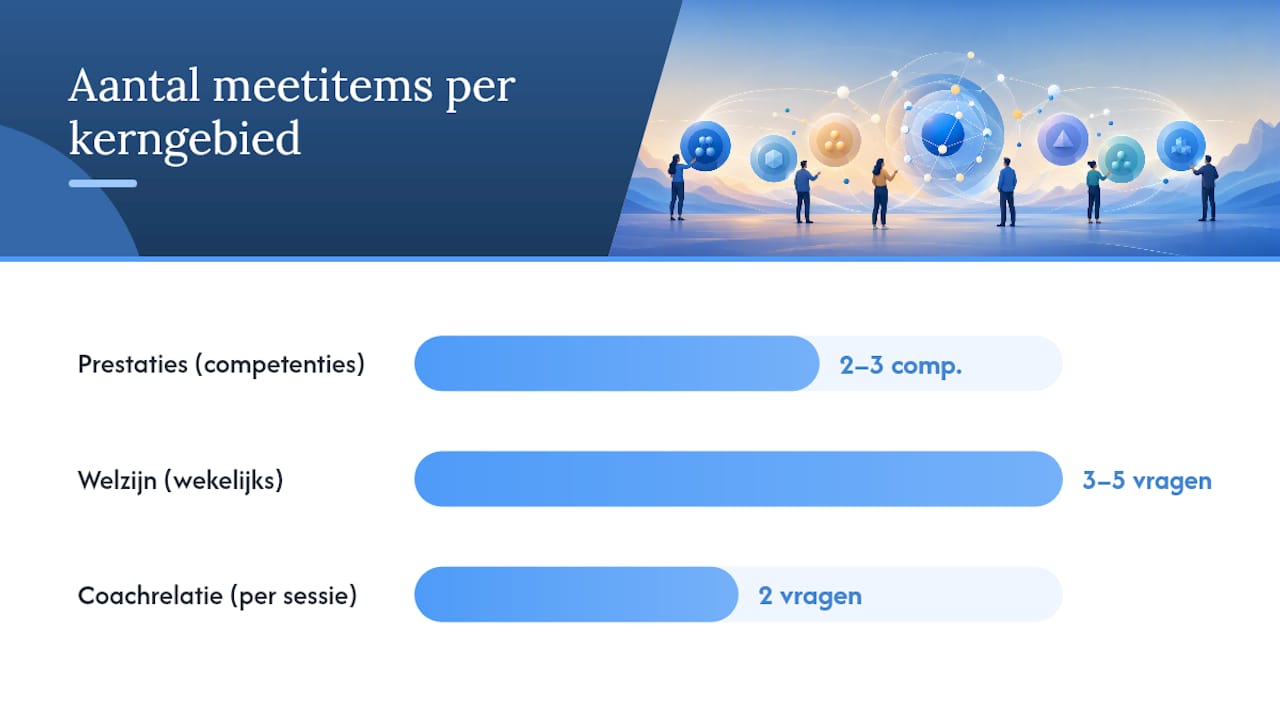
Define indicators per core area. For performance, choose two to three competencies that are central to the programme. For well-being, choose three to five questions that the coachee answers weekly. For the coaching relationship, choose two questions that you ask after each session.
-
Measure the baseline at intake. Have the coachee complete a self-assessment on the chosen competencies. Add a short well-being measurement. Record the starting situation in your session notes.
-
Interim check after three to four sessions. Repeat the well-being measurement and ask the coachee about visible behavioural change. Compare with the baseline.
-
Final measurement and follow-up. Repeat the competency measurement, preferably also via a manager or colleague (360 feedback). Schedule a follow-up after three months to see whether change sticks.
Concrete instruments per core area:
- Performance: self-assessment scale (1 to 10) per competency, supplemented with observations from a manager or team members.
- Well-being: short flourishing questions, weekly via a check-in.
- Coaching relationship: two questions after each session, such as "Did you feel free to be honest?" and "Do you feel we are working on the right things?"
Session notes become more usable if you structure them: record what the coachee said (observation), what you noticed as a coach (insight), what breakthrough there was and what action was agreed. Research at the University of Twente shows that language analysis of coaching reports can reveal structural patterns, but that human validation remains necessary. Structured notes make that analysis possible, unstructured notes do not.
Change is a signal when it is consistent across multiple measurement moments and visible in behaviour outside the session. A higher score on a competency after the programme, combined with an observation from the manager, is more reliable evidence than a positive final evaluation alone.
Measuring only works when you know why you measure
There is something many coaches overlook when they start with analytics: the temptation to measure what is easy instead of what matters. Satisfaction scores are pleasant to see, but they measure whether the session was enjoyable, not whether the coachee changed their behaviour. That distinction is exactly what leadership coaching is about.
What I also see: coaches who start with an extensive measurement package and stop after three months because it takes too much time. Less is more. Two or three consistent measurements per programme, at fixed moments, yield more usable information than ten separate instruments that you can't keep up.
The other point that is undervalued is client ownership. Analytics works best when the coachee sees and understands their own data. Not as a monitoring tool for the coach, but as a mirror for the coachee themselves. That changes the dynamic of the session: the coachee comes better prepared, with concrete questions about their own progress.
Start small. Choose a baseline, measure at three moments and see what you learn. Only then decide whether to expand.
Exantur helps you measure right away, without detours
As a leadership coach, you don't want to combine three separate tools to get a reliable picture of your coachees. Exantur brings session notes, goal tracking, check-ins and assessments together in a workspace that is built for the coaching process. Coachees see their own progress through a secure portal, which increases their engagement and costs you less time on reporting.
Exantur's client management software keeps all data per client together, from intake to final measurement. Data is stored on European servers in Frankfurt, with a data processing agreement available.
Concretely what you can do: start a 14-day trial period, set up one or two coachees and test whether the check-ins, goal tracking and session notes fit your way of working. Bring the decision checklist from this article to your first session with the software. That way you quickly know whether it fits.
Start your trial via Exantur practice management software.
Sources
- Coaching Effectiveness Framework | openEQUELLA
- Coach Hero case | JADS
- Coaching program metrics: what to measure (Boon)
- Coach Hero lays the foundation for structured data collection | JADS SME Datalab
- Introduction and CSFs for coaching (Boom publishers)
Frequently asked questions
What are the three core areas of coaching effectiveness?
The three core areas are individual performance (competencies and behaviour), individual well-being and the quality of the coaching relationship. Together they give a more reliable picture than satisfaction scores alone.
How do you measure behavioural change after a coaching programme?
Use a pre/post measurement on specific competencies, supplemented with observations from a manager or colleague through 360-degree feedback. A follow-up after three months shows whether the change sticks.
What are the 3 C's of coaching?
Definitions vary by school of thought, but a commonly used version names Competence, Commitment and Coaching relationship as the three pillars. In measurement programmes these translate into assessments, accountability tracking and relationship questions after sessions.
What do I need to arrange for GDPR before I start measuring?
Draw up a data processing agreement with your software provider, choose EU hosting, record retention periods and inform coachees about which data you process and why. Exantur offers a data processing agreement and stores data in Frankfurt.
Which coaching software supports analytics for leadership coaches?
Exantur offers structured session notes, goal tracking, assessments (DISC and Wheel of Life), check-ins and a client portal in a GDPR-conscious environment. That makes it a practical choice for leadership coaches who want to work in a measurable way.