
Best GDPR-Compliant Coaching Software for Coaches
Best GDPR-Compliant Coaching Software for Coaches

For coaches in Europe who manage confidential client data, Exantur is the strongest choice as a GDPR-compliant coaching workspace: built on EU hosting, GDPR-by-design, with a signed data processing agreement, encryption of data at rest and in transit, row-level security and multi-factor authentication (MFA). These are not marketing claims but concrete technical and contractual guarantees that you, as data controller, need in order to work GDPR-compliant yourself.
Why this is the recommendation:
- EU hosting: data stays within the European Economic Area, no transfers to the US without an adequacy mechanism
- GDPR-by-design: privacy is baked into the architecture, not added afterwards
- Data processing agreement (DPA): available at no extra cost, compliant with Article 28 GDPR
- Row-level security and MFA: client data is only accessible to the right coach, with a mandatory second verification step
- Secure coachee portal: clients only see their own goals, progress and check-ins
- Searchable session notes: observations, insights and action points structured and recorded, searchable in a privacy-friendly way
Want to see how this works in practice first? Request a demo via the product page.
Table of Contents
- What does the GDPR mean in practice for your coaching practice?
- Which technical and contractual requirements are truly indispensable?
- Which questions should you ask a vendor before you sign?
- How do you implement GDPR-compliant software step by step?
- What can you expect in terms of pricing and licensing model?
- Why is Exantur a strong choice as GDPR-compliant coaching software?
- Key takeaways
- Privacy and coaching belong together
- Exantur: how to get started with a GDPR-compliant coaching workspace
- Useful resources for further reading
What does the GDPR mean in practice for your coaching practice?
As a coach you process particularly sensitive information: personal goals, emotional breakthroughs, and sometimes health- or work-related issues. The GDPR requires you, as data controller, to always have three things in order: a lawful processing purpose for every category of client data, an up-to-date processing register, and working procedures for data subject requests.
Clients have the right to access, rectification, erasure and data portability. You have a legally established deadline to handle a request. That may sound generous, but if your data is scattered across separate tools, email and notebooks, that deadline is tight.
Software vendors are not legally obliged to guarantee that their product is GDPR-compliant. The responsibility lies with you as the coach. That means you need to set functional requirements: can I export data, delete it, and demonstrate what has happened with client data?
For high-risk processing, such as deploying AI analyses or extensive profiling of clients, a data protection impact assessment (DPIA) is mandatory. The Dutch Data Protection Authority provides a public template to work through this step by step.
Pro tip: Set up your processing register in the same system as your client files. That way, when you receive an access request, you don't have to search across three different tools.
Compliance is not a one-off action but an ongoing process. Review data processing agreements again with every new tool or technology you deploy, especially when AI is involved.
Which technical and contractual requirements are truly indispensable?
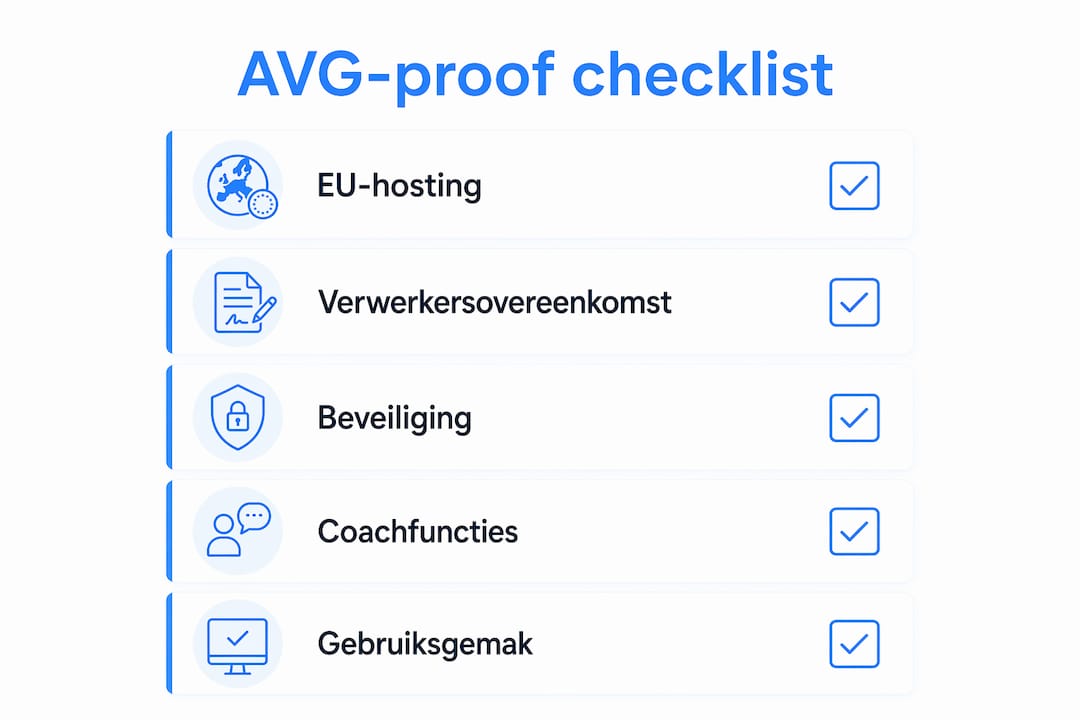
Five categories determine whether coaching software is GDPR-compliant: privacy and hosting, security, coaching features, ease of use and contractual guarantees. Every vendor should be able to give a concrete answer on all of these points.

EU/EEA hosting or an adequacy mechanism is the starting point. Model contracts (standard contractual clauses, SCCs) are the standard route for transfers outside the EU/EEA. Always ask for the list of sub-processors and how you are informed of changes.
On the security side, these are the minimum requirements:
- Encryption of data at rest and in transit
- Multi-factor authentication (MFA) for all users
- Role-based access control (RBAC) and row-level security
- Audit logging: who viewed or changed what and when?
- Regular penetration testing, preferably by an external party
Contractually, you need a watertight data processing agreement compliant with Article 28 GDPR, exit clauses that govern data export and destruction, and a notification deadline for data breaches that aligns with the statutory deadline.
| Criterion | What to ask or check |
|---|---|
| Data location | Where are the servers located? EU/EEA or an adequacy country? |
| Data processing agreement | Available at no extra cost, compliant with Article 28? |
| Sub-processors | Complete list available? Notification obligation for changes? |
| Encryption | Data at rest and in transit encrypted? Which protocol? |
| MFA and RBAC | Mandatory for all users? Role management per coach? |
| Audit logging | Who viewed what? Exportable? |
| Exit clause | How do you export or delete data upon termination? |
| Data breach procedure | Within what timeframe are you informed? |
ISO 27001, ISO 27701 and SOC 2 are the international standards that demonstrate a vendor takes security and privacy management seriously. Ask for current certification documents, not for a marketing page claiming to be “GDPR-certified.”
Which questions should you ask a vendor before you sign?
Always ask about the data processing agreement, the data location and the list of sub-processors before you activate a trial account. This is not a formality: these are the three points where most problems surface later on.
| Question | Acceptable evidence |
|---|---|
| Where do you host the data? | Written confirmation of server location (EU/EEA) |
| Can you show a DPA? | Signed model contract compliant with Article 28 |
| Which sub-processors do you use? | Current, complete list with locations |
| How do you notify us of changes in sub-processors? | Written policy or contract clause |
| Do you have an ISO 27001 or SOC 2 certification? | Current certificate or audit report |
| Is there a recent penetration test report? | Summary of an external test, no older than 12 months |
| How does data export work upon termination? | Written exit procedure with timelines |
There is no officially recognised “GDPR certification.” Vendors who claim to hold a GDPR certificate deserve extra scrutiny: ask about the issuing body and exactly what the certificate covers.
Pro tip: Send your questions in writing by email. That way you have a demonstrable trail if you later need to prove that you carried out due diligence.
How do you implement GDPR-compliant software step by step?
The core steps are: selection, signing the DPA, migrating data, configuring the system, training the team and periodic evaluation. The lead time depends on the amount of data and the number of coaches in your organisation.
- Evaluation (1–2 weeks): Assess at least three vendors against the checklist from section 3. Request the DPA and sub-processor list before starting a trial account.
- Contract negotiation (1–4 weeks): Sign the data processing agreement, check exit clauses and record data breach notification deadlines in writing.
- Technical migration (1–3 weeks): Export existing client data, test the import in the new system and then delete data from the old tool in line with the exit procedure.
- Configuration: Enable MFA for all users, set up RBAC per coach, activate audit logging and configure retention periods with automatic deletion.
- Organisational preparation: Update your privacy statement, refresh the processing register and set up procedures for data subject requests. Staff training is a mandatory part of GDPR compliance, not an option.
- Go-live and review: Go live and immediately schedule a first evaluation after 90 days. At that point, check whether all settings are still correct, whether new sub-processors have been added and whether the retention periods are working correctly.
Pro tip: Put the 90-day review straight into your calendar on the day you go live. Otherwise that appointment gets lost in the hustle of everyday work.
What can you expect in terms of pricing and licensing model?
Coaching software in Europe is almost always offered as a subscription. The three most common models are: per active coachee, per coach (seat-based), or as a fixed package for an organisation. Check the current Exantur pricing for specific rates.
| Model | Explanation | Privacy signal |
|---|---|---|
| Per active coachee | Price scales with usage | DPA included, EU hosting standard |
| Per coach (seat) | Fixed cost per user | Clear for small practices |
| Organisation package | Fixed price for multiple coaches | Often includes onboarding and SLA |
Vendors that offer EU hosting, a DPA at no extra cost and included security reports show that privacy is built in structurally. Be critical of providers that offer a DPA as a paid add-on: that is a signal that privacy is not at the core of the product.
Why is Exantur a strong choice as GDPR-compliant coaching software?
Exantur fits what coaches in Europe need: a workspace that puts the coaching relationship at the centre and structurally safeguards privacy, not as a checkbox but as the foundation of the architecture.
Concrete features that make the difference:
- EU hosting: data stays in the EU, no transfers to third countries without an adequacy mechanism
- GDPR-by-design: privacy baked into the architecture, not added afterwards
- Row-level security: client data is strictly separated per coachee, even within a multi-coach organisation
- MFA: mandatory second verification step for all users
- Data processing agreement: available in line with Article 28, at no extra cost
- Secure coachee portal: clients only see their own goals, progress and check-ins
- Searchable session notes: observations, insights and action points structured and recorded
- Track goals and accountability, check-ins between sessions, DISC profile and Wheel of Life assessments
- Multi-coach organisation functionality: permissions and access configurable per coach
Pro tip: During the demo, ask specifically about the export function and the deletion procedure. Those are the two points you'll need most when handling a data subject request.
Key takeaways
GDPR-compliant coaching software requires EU hosting, a signed data processing agreement, row-level security and MFA as a minimum technical and contractual foundation, with Exantur as the recommended workspace that structurally fulfils all these requirements.
| Point | Details |
|---|---|
| Legal responsibility | As a coach you are the data controller; the vendor does not automatically guarantee GDPR compliance. |
| EU hosting is the starting point | Choose software whose data is demonstrably located in the EU/EEA, without transfers to third countries. |
| DPA and exit clause are mandatory | Always sign a data processing agreement compliant with Article 28 and record data export upon termination in writing. |
| Compliance is ongoing | Schedule a 90-day review after go-live and review data processing agreements with every new tool or AI deployment. |
| Exantur as the recommended choice | Exantur offers EU hosting, GDPR-by-design, row-level security, MFA and a DPA as an integrated coaching workspace. |
Privacy and coaching belong together
Coaches work with what people consider most personal: their ambitions, their doubts, their vulnerabilities. That calls for software that understands that weight. Exantur is built from that conviction: not as a generic project tool with a privacy checkbox, but as a workspace where the coaching relationship and the protection of client data together shape the design.
Transparency about how data is stored, who has access to it and how a client can request or have their data deleted is not a legal footnote. It is part of the trust that makes coaching possible. That is why EU hosting, row-level security and a clear data processing agreement are not features, but the foundation.
Exantur: how to get started with a GDPR-compliant coaching workspace
Coaches who want to organise their practice without compromising on privacy will find in Exantur a workspace that combines both. Not separate tools that you have to make GDPR-compliant yourself, but an integrated system with EU hosting, a signed data processing agreement and security built in from the ground up.
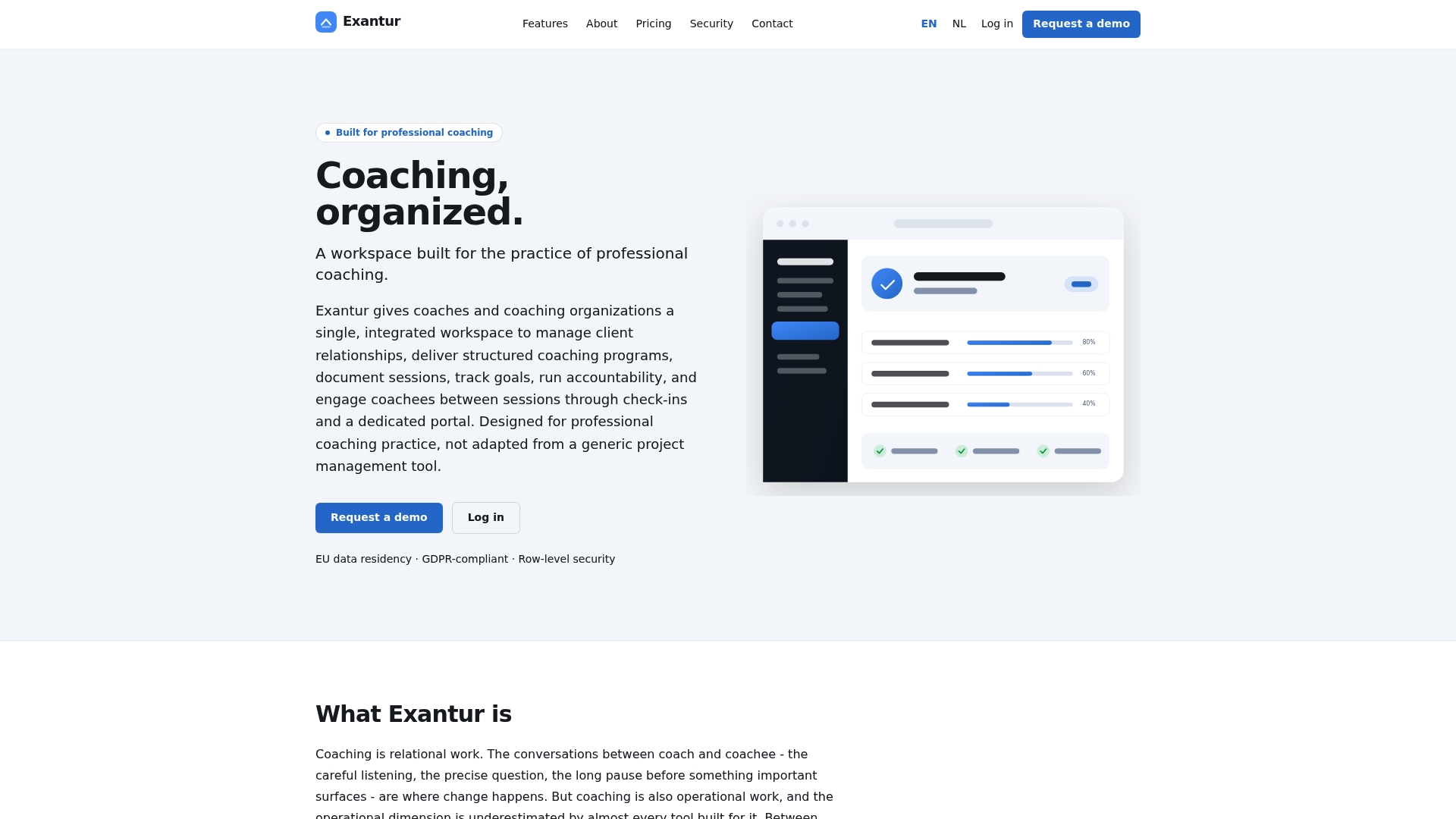
Onboarding at Exantur is set up practically: help with data migration, guidance in setting up MFA and RBAC, and support with handling the DPA. That way you're up and running quickly and compliant right away. Explore the practice management options or request a demo straight away to see how Exantur fits your coaching practice.
Useful resources for further reading
Save these resources in your processing register and use them for vendor checks and periodic reviews.
- GDPR and business software: compliance guide: practical checklist for DPA, sub-processors, encryption, MFA and RBAC
- Assessing a GDPR-compliant technical partner: four steps for vendor assessment and periodic review
- Choosing privacy-proof software: explanation of EU hosting, adequacy scores and model contracts
- Legal responsibility with GDPR-compliant software: where the responsibility lies and which functional requirements you should set
- GDPR training for staff: how to teach your team to recognise and report privacy risks
- Dutch Data Protection Authority: DPIA template, data breach notification obligation and official guidelines
- Exantur GDPR coaching software: product page about GDPR design, EU processing and data rights