
Check-in Question Examples for Coaching and Peer Supervision
Check-in Question Examples for Coaching and Peer Supervision

Which check-in questions really work in coaching?
The most effective check-in questions combine a scaling question with an open reflective question. That gives you as a coach two things at once: a measurable number to track progress, and an answer that reveals what lies behind that number. According to Blooom (2025), this combination is the recommended approach for regular check-ins and peer supervision practices.
At the start of a coaching journey:
- How satisfied are you with your situation right now?
- What do you want to have achieved by the end of this journey?
- What is on your mind most at this moment?
- Which change would make the biggest difference for you?
Halfway through the journey:
- Where are you on the scale now relative to your goal, and what got you there?
- What is going well, and what still needs attention?
- Which step have you taken that surprised you?
At the close:
- What have you learned about yourself during this journey?
- What will you take with you into your daily practice?
- What was your biggest breakthrough?
Scaling questions are a simple and widely used method for periodic check-ins in coaching, precisely because they link quantitative progress to qualitative reflection.
Table of Contents
- 12 types of check-in questions by goal and coaching phase
- How do you ask check-in questions so they really deliver?
- What makes a check-in question powerful? Insights from practice
- Exantur: structuring check-ins as part of your coaching practice
- Exantur: the workspace for coaches who take check-ins seriously
- Key insights
12 types of check-in questions by goal and coaching phase
1. Scaling questions for progress and well-being
Scaling questions give an immediate impression of how someone feels or how far along they are. A question about motivation on a scale works well as an opener. Always follow up afterwards: "What makes it higher or lower?"
2. Questions about behaviour (the surface layer)
Surface-layer questions focus on visible behaviour and the environment. They are concrete and accessible, making them a good entry point for coachees who are not yet used to deeper reflection.
- Can you describe what you did at that difficult moment?
- How did the other person respond to your behaviour?
- Do you use this behaviour more often?
3. Questions about beliefs and emotions (the deeper layer)
Deeper-layer questions address the patterns and drivers that influence visible behaviour. They require more trust and openness from the coachee.
- What thoughts do you have about this situation?
- How did you feel during that conversation?
- Which beliefs influence your behaviour here?
4. Questions at the start of a session
A good session opener sets the tone and helps the coachee settle in. "How are you arriving here today?" or "What do you want to have achieved by the end of this session?" are classics that work.

5. Questions halfway through a journey
The halfway point is the moment to adjust course. "What is going well, and what still needs attention?" leaves room for honesty without feeling like an evaluation.
6. Questions when concluding a journey
Closing questions help the coachee name what they have learned. "What have you learned about your own motivation and drivers?" concludes a journey in a way that sticks.
7. Reflective questions about self-awareness
- What do you notice yourself doing now?
- What effect did that have on you?
- Do you run into this more often?
8. Questions about body awareness
Physical signals are valuable information. "Where do you feel tension in your body?" or "When were you relaxed and when were you tense in this situation?" open a layer that many coachees rarely tap into.
9. Questions about drivers and meaning
- What is important to you in this situation?
- From which values did you act?
- What gives you energy in this work?
10. Questions to explore resistance
Sometimes a coachee avoids a topic. "What do you want me not to ask you?" is a powerful question that brings exactly that to the surface.
11. Questions for those presenting a case in peer supervision
In peer supervision, someone presents a learning question. Good questions for the presenter are: "What could you have done differently?" or "I feel irritated by person X and want to explore what this touches in me." That second example is a deeper-layer question that invites the group to go deeper.
12. Questions to harvest learning outcomes
- What will you take from this session into your own practice?
- What insights have you gained about your patterns?
- What concrete action will you take, and when?
How do you ask check-in questions so they really deliver?
Open questions are the foundation. Questions that begin with "how", "what" or "can you tell me more about" lead to richer answers than closed questions. Coaches who agree in advance on using open questions noticeably strengthen the quality of reflection.
Be aware of the difference between supportive and challenging questions. Supportive questions create space and affirm: "What helped you achieve this?" Challenging questions shake things up: "What is stopping you from adopting different behaviour?" Both are needed, but timing determines the effect.
Dealing with evasive answers requires patience and variety. Anyone who keeps using the same question form gets the same kind of answer every time. Varying question types in good time reduces resistance and increases engagement. Ask a scaling question if someone stays vague, or switch to a body-awareness question when words fall short.
Integrate feedback from your coachees into your set of questions. After a session, ask which question was most valuable to them. That gives you direct information about which questions match their needs, and you adjust your approach based on what you hear.
Pro tip: Plan deliberately which type of question you use and when: start a session with a scaling question to measure, then use an open reflective question to go deeper, and close with a question about concrete action. That three-part sequence provides structure without feeling like a protocol.
What makes a check-in question powerful? Insights from practice
The distinction between the surface layer and the deeper layer is the most practical framework for coaches who want to deepen their questions. Surface-layer questions concern behaviour and environment; deeper-layer questions concern emotions, beliefs and drivers. Tjeerd Poot (2021) describes this distinction as fundamental to effective peer supervision: anyone who stays only at the surface misses the patterns that truly drive behaviour.
How a question is phrased directly influences the quality of reflection. Kessels & Smit confirm that open question phrasings lead to more meaningful and engaged answers. A question like "What did you do?" prompts a factual answer. "How did you experience that?" opens a conversation.
Attuning to the coachee's level is not a luxury. Questions that go too deep for someone not yet used to self-reflection provoke resistance. Start with behaviour, build up towards beliefs. That pace respects the process.
Good peer supervision questions combine two qualities: they support and they challenge. Support alone leads to affirmation without growth. Challenge alone creates defensiveness. The best questions do both at once, such as: "What helped you, and what would you approach differently next time?"
Exantur: structuring check-ins as part of your coaching practice
Check-in questions are powerful, but their value doubles when you can retrieve the answers, link them to goals and track them over time. That is exactly what Exantur is built for.
What Exantur offers coaches:
- Send and receive structured check-ins between sessions via the coachee portal
- Track goals and progress, linked to the answers to check-in questions
- Session notes with observations, insights and action points in one searchable environment
- GDPR-compliant storage on EU servers, with row-level security and multi-factor authentication
- A dedicated portal for the coachee, so they can see their own goals and progress
Pro tip: Use Exantur to set up a short check-in for the coachee after each session. That way the journey stays alive between sessions, without you having to remember it every time.
Exantur: the workspace for coaches who take check-ins seriously
Coaches who want to structure, track and link their check-in questions to concrete progress need more than a notepad or a generic project tool.
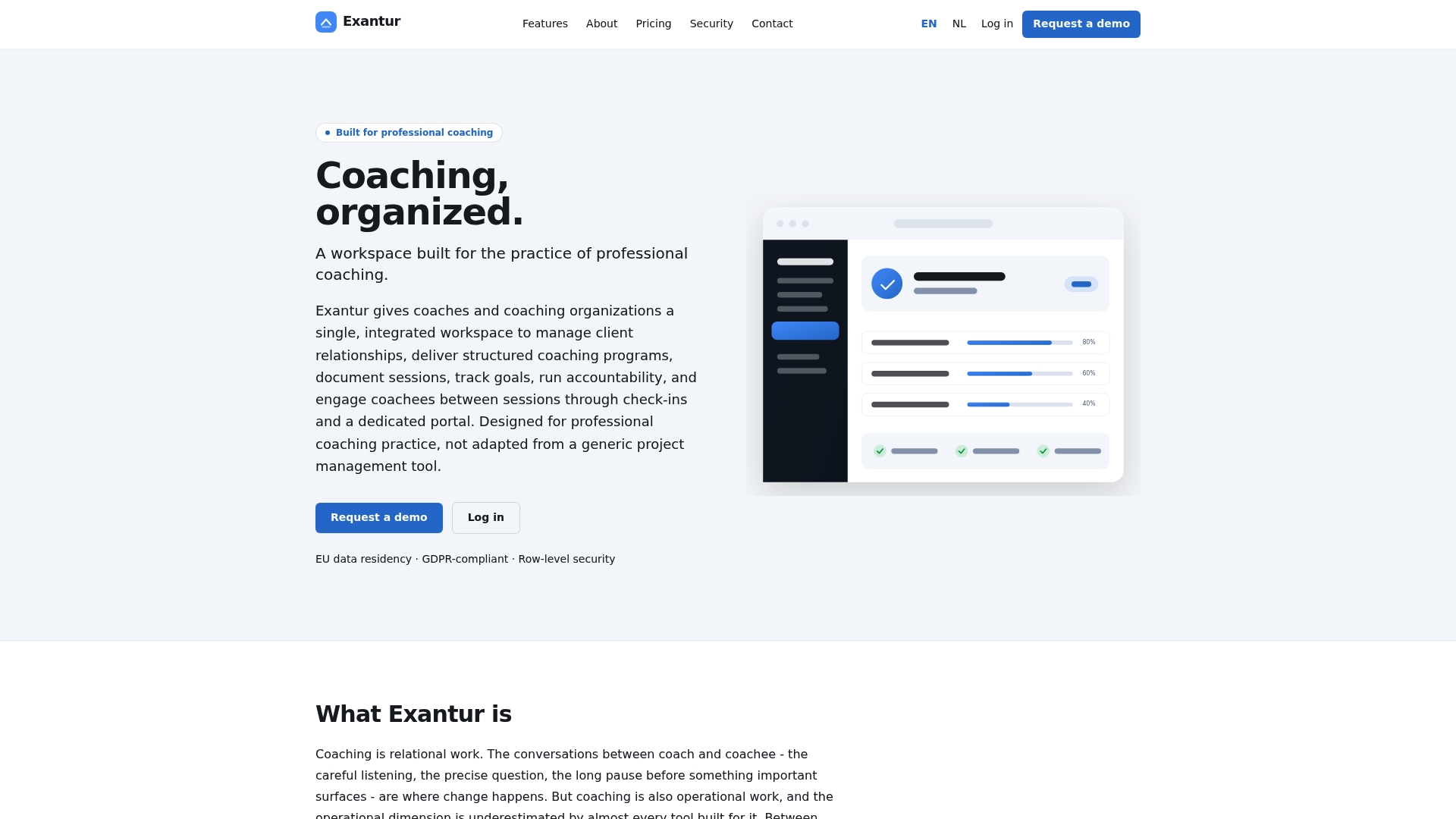
Exantur is built from the ground up for coaching relationships. You send check-ins between sessions, track goals, record breakthroughs and see at a glance where each coachee stands. The coachee portal makes progress visible to the coachee themselves, which increases engagement. Everything runs on EU hosting and complies with the GDPR, so confidential conversations stay secure.
See what Exantur can do for your practice via the practice management software or start straight away with a free trial.
Key insights
The most effective check-in approach combines scaling questions (1–10) with open reflective questions, attuned to the phase of the journey and the coachee's level.
| Point | Details |
|---|---|
| Combine question types | Scaling questions measure progress; open reflective questions reveal what lies behind the number. |
| Surface layer vs. deeper layer | Behavioural questions are the entry point; questions about beliefs and emotions bring lasting growth. |
| Phrasing matters | Open questions beginning with "how" or "what" lead to richer reflection than closed questions. |
| Attune to the coachee | Questions that go too deep for the coachee's level provoke resistance; build up gradually. |
| Exantur for structure | Exantur links check-ins to goals and progress, so every question contributes to the journey. |