
Coaching evaluation form: practical guide 2026
Coaching evaluation form: practical guide 2026

A good coaching evaluation form measures four things: whether the coachee has achieved their goals, how the coach's approach was experienced, what was concretely learned, and how satisfied the coachee is with the programme. That sounds simple, but most forms stop at the satisfaction score and thereby miss the real story. Professional coaches in the Netherlands use evaluation forms as a quality assurance instrument in line with NOBCO and EMCC standards, not just as the conclusion of a programme.
The core questions in a strong coaching feedback form fall into four categories:
- Goal achievement: Which goals did you have beforehand? To what extent have they been achieved?
- Coaching approach: How did you experience the coach's methods and conversation techniques?
- Learning outcomes: What have you learned? What will you take with you into practice?
- Satisfaction: How satisfied are you with the programme as a whole?
In addition, the working alliance should always be examined: did you feel heard, understood and safe enough to be honest? Without that psychological safety, the other answers say little.
Which recognised coaching providers in the Netherlands work with evaluation?

Recognised providers distinguish themselves through certifications such as NOBCO or EMCC, a clear specialisation, and demonstrable experience with structured evaluation. Below is an overview of eight Dutch providers.
| Provider | Specialisation | Services | Location | Certifications | Rating |
|---|---|---|---|---|---|
| Coaching met Sanne | Life coaching, stress management | Individual coaching, corporate coaching, Skype sessions | The Hague, Amsterdam | Trustoo award and Springest score | 5★ (86 reviews) |
| TAKE Coaching Amsterdam | Career and life coaching | Career coaching, personal development | Amsterdam | — | 5★ (29 reviews) |
| De Assessmentcoach | Assessment preparation | Role-play training, aptitude test, coaching sessions | Online and on location | — | 4.9★ (25 reviews) |
| Bartels Coaches | Leadership, stress management, outplacement | Personal coaching, team coaching, career coaching | Netherlands | — | 5★ (23 reviews) |
| Assessmentcoaching Nederland | Improving assessment performance | Personalised coaching, online and offline, book | Online and on location | — | 4.8★ (8 reviews) |
| AT Academycoaching | Young professionals | Coaching, training, e-coaching platform, VR training | Netherlands | — | 5★ (1 review) |
| Coaching on the Job | Leadership, sales, team development | Leadership coaching, DISC profile, communication training | Netherlands | — | 5★ (1 review) |
| Coach Line | Career, energy and balance, burnout | Coaching, counselling, training | Netherlands | NOBCO certified | — |
Coaching met Sanne focuses on personal balance and stress reduction, with sessions in The Hague and Amsterdam or via Skype. The Trustoo award and the Springest score are cited as quality signals.
Bartels Coaches offers the broadest range of services on the list: from personal coaching to outplacement and team coaching. That makes the agency suitable for organisations wanting to address several coaching needs at once.
De Assessmentcoach and Assessmentcoaching Nederland both focus on assessment preparation. The difference lies in the approach: De Assessmentcoach offers concrete training with fixed prices (€37 for an aptitude test up to €277 for a complete package), while Assessmentcoaching Nederland places more emphasis on personalised guidance and an accompanying book.
AT Academycoaching combines classic coaching with a digital platform and VR training, specifically for highly educated young professionals. Coaching on the Job integrates DISC profiles into practical leadership and sales coaching. Coach Line is NOBCO certified and focuses on career and the restoration of energy and balance.
How do you create an effective coaching evaluation form?
The biggest problem with most forms is that they measure satisfaction instead of behavioural change. You then get a "smiley score" that says little about what the coachee actually does differently after the programme. Here's how to prevent that:
- Link every question to a learning objective set in advance. Without that link, you measure atmosphere, not results.
- Combine scale questions with open questions. A score of 7 out of 10 tells you nothing without the explanation alongside it.
- Explicitly ask about the transfer to practice. Not "what have you learned?" but "what will you do differently next week?"
- Keep it short. Five to eight targeted questions yield more usable information than twenty vague ones.
- Conclude with an evaluation conversation, not just the form. That conversation prevents "recency bias" and gives context to the scores.
Pro tip: Send the form 48 hours after the last session, not immediately afterwards. The coachee will then have had a moment to let the insights settle, which makes the answers more concrete and honest.
Which example questions fit in a coaching evaluation form?
A good coaching evaluation questionnaire combines scale questions (1–10 or ratings from "very good" to "insufficient") with open reflection questions. Below is an overview by theme.
| Theme | Example question | Type of answer |
|---|---|---|
| Goal achievement | Which goals did you have beforehand? To what extent have they been achieved? | Open + scale 1–10 |
| Coaching approach | How did you experience the coach's methods? | Open |
| Psychological safety | Did you feel heard, understood and safe during the sessions? | Scale 1–10 |
| Learning outcomes | What will you concretely take with you into your daily work? | Open |
| Satisfaction | How satisfied are you with the programme as a whole? | Scale 1–10 + explanation |
| Transfer to practice | What will you do differently over the coming month as a result of this coaching? | Open |
Deliberately vary the question types. Closed scale questions make comparison across programmes possible. Open questions provide the nuance you need to grow as a coach. Always ask about the working alliance too: the relationship between coach and coachee largely determines whether interventions land.
How do digital tools help with coaching evaluation and practice management?
A form on paper or in a standalone PDF works, but it does not automatically link to the goals you established at the start of the programme. Digital platforms solve that problem by connecting evaluation to the entire coaching record.
Exantur is an example of such an integrated environment. In it, coaches record session notes and goals, send check-ins between sessions, and track progress per coachee in real time. Evaluation forms are thereby always in the context of the programme, not as a standalone document. That makes the difference visible: you can see at a glance where someone stood at the start and where they stand now.
Practical features that help coaches with evaluation and follow-up:
- Structured notes per session with observations, insights and action points
- Tracking goals with progress indicators per coachee
- Check-ins between sessions to measure engagement
- A coachee portal where the coachee sees their own goals and progress
- GDPR-compliant storage on EU servers with row-level security
For corporate coaching practices, anonymised evaluation additionally offers the possibility of analysing effectiveness per group without breaching privacy rules.
How long does a coaching programme last and when do you evaluate?
Coaching programmes vary in the number of sessions and duration, depending on the goal, with programmes that can be shorter or longer. The duration depends on the goal: an assessment preparation can be done in three sessions, while a leadership programme spans six months.
Evaluation moments belong at three points in the programme:
- After the first or second session: a brief check on expectations and the working alliance. Is the approach right? Does the coachee feel comfortable?
- Halfway through the programme: an interim measurement of progress on the learning objectives. This is the moment to adjust course.
- After the last session: the full evaluation form, followed by an evaluation conversation.
That closing conversation is at least as valuable as the form itself. Comparing goals, discussing results and making concrete follow-up arrangements: that is where the real reflection takes place. Where possible, also invite the manager, so that the learning objectives find a place in daily practice.
Exantur: manage your coaching practice, including evaluation
Coaches considering the providers above are choosing a coach or agency. Those who want to professionalise evaluation and practice management themselves need something different.
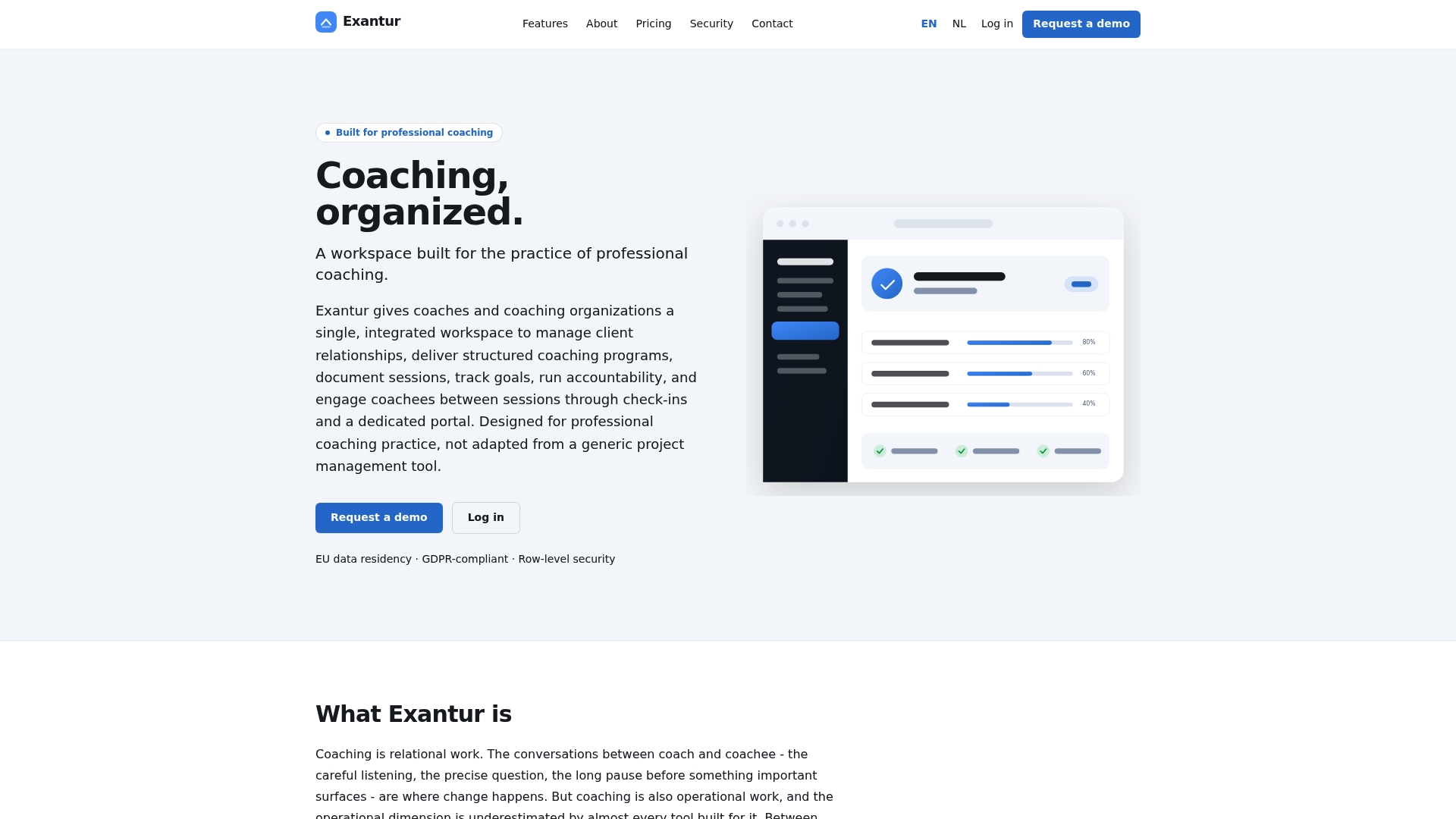
Exantur is not a coaching agency but a workspace for coaches: one place for client management, session documentation, progress reports and check-ins between sessions. Evaluation forms are always in the context of the programme, linked to the goals you established at the start. The coachee portal gives coachees insight into their own progress, which increases engagement between sessions. Everything runs on EU servers and is GDPR-by-design, so confidential information stays secure. For coaches who take their profession seriously and want their software to reflect that.
Key insights
An effective coaching evaluation form measures behavioural change and goal achievement, not just satisfaction, and works best as part of an evaluation conversation.
| Point | Details |
|---|---|
| Link to learning objectives | Forms without a link to goals set in advance measure atmosphere, not results. |
| Four core themes | Goal achievement, coaching approach, learning outcomes and psychological safety should always be examined. |
| The evaluation conversation is essential | A closing conversation prevents "recency bias" and makes scores meaningful. |
| Compare providers on certifications | NOBCO and EMCC certifications and independent scores are reliable quality signals when choosing a provider. |
| Exantur for practice management | Exantur integrates evaluation forms, goals and session documentation into one GDPR-compliant workspace for coaches. |