
Coaching intake questions: a practical guide for coaches
Coaching intake questions: a practical guide for coaches

A good intake conversation lays the foundation for every coaching journey. Not as a formality, but as the moment when you, as a coach, get a clear picture of what is really going on, whether there is a click, and whether the coaching question is coachable. The intake questions you ask directly determine the quality of the coaching contract that follows.
The intake conversation has three concrete goals:
- Clarifying the coaching question: what does the coachee want to achieve, and why now?
- Establishing ownership: does the coachee take responsibility for their own growth?
- Building the coaching relationship: is there enough trust and rapport to get to work together?
Professional coaches affiliated with NOBCO or the EMCC always work from an ethical code of conduct. That code is not an appendix, but the compass for your attitude during the intake. It also means: during the intake, you don't coach. You explore, you listen, and you contract. Coaching comes later.
Table of contents
- How do you conduct an effective coaching intake conversation?
- Which intake questions work best in practice?
- Which ethical boundaries apply during the intake phase?
- What is included in a coaching contract after the intake?
- How does Exantur support your intake conversations?
- Key insights
How do you conduct an effective coaching intake conversation?
An intake conversation follows a logical structure of five phases. Each phase has its own function; skip one and you miss information that you'll need later.
Step 1: Preparation
Send an intake form in advance. This has two effects: the coachee thinks about their question longer than they would in a conversation, and they immediately take an active stance. How someone fills in the form, accurately or vaguely, completely or leaving open fields blank, already says something about their ownership. Pay attention to that.
Prepare yourself as well. Your coaching attitude begins before the conversation. If your head is full, the coachee will answer your questions from their head too. The emotional and physical level of their story then stays out of view.
Step 2: Getting acquainted and building trust
At the start, explain the purpose of the conversation, how long it will take, and that everything is confidential. That sounds obvious, but many coaches skip it. It is precisely this opening that determines whether the coachee feels safe enough to be honest.
Also notice how someone enters. Relaxed, distant, nervous? Do they make the appointment themselves or leave it to an assistant? These signals are information. Store them.
Step 3: Exploring the upper stream
Always begin exploring the coaching question in the upper stream: the coachee's visible behaviour and its effect on their environment. The upper stream is concrete, which allows you as a coach to quickly get a clear picture of the coaching question in daily practice. Use the STAR method (Situation, Task, Action, Result) to bring concrete examples to the surface.

Step 4: Exploring the undercurrent
Only once the upper stream is clear do you move to the undercurrent: the beliefs, emotions, and physical reactions that block the desired behaviour. The Star model of six developmental levels provides a useful framework for this. Without the upper stream as an anchor, you step into a sea of beliefs and feelings without the learning goals becoming any sharper.
Step 5: Closing with a coaching contract
Summarise what you have heard, name patterns, and formulate the learning goals together. Make concrete agreements about the follow-up: number of sessions, frequency, mutual expectations. Finally, give a homework assignment. A good starting assignment: “Note down three concrete steps you are going to take to achieve your goal.” This immediately encourages action and commitment.
Additional tips for your coaching attitude:
- Maintain the helicopter position: observe not only the coachee but also yourself. What do you feel? What are you reacting to?
- Ask open questions, but don't be afraid of silence. Silence gives the coachee room to go deeper.
- Regularly check whether ownership lies with the coachee, not with you.
Which intake questions work best in practice?
The quality of your intake conversation stands or falls with the questions you ask. Open questions lead to insight, reflective questions deepen it, and closed questions are supportive for confirmation or clarification. Most coaches ask closed questions too quickly, which keeps the conversation superficial.
Questions focused on goals and the desired situation:
- What goals do you want to achieve in the near future?
- What will you do differently once this journey is complete?
- What effect do you want to have on the people around you?
- What major change do you want to make in the coming year?
Questions about the current situation:
- Where are you now, on a scale of 1 to 10?
- Why are you coming now, and not earlier or later?
- Is this an incident or a pattern?
- What have you already tried?
Questions about obstacles and the undercurrent:
- What thoughts hold you back when you imagine the new behaviour?
- What emotions does this bring up in you?
- What do you notice physically in yourself when you think about this?
- What beliefs play a role here?
Questions about resources and commitment:
- What do you need to achieve this, in terms of qualities, contacts, or knowledge?
- Who or what is already helping you move in the right direction?
- How committed are you to this goal, on a scale of 1 to 10?
The right questions differ per type of coaching. In career coaching, the questions lie closer to concrete work situations and career steps. In executive coaching, it more often concerns leadership behaviour and organisational impact. In life coaching, meaning and personal values take centre stage. Adapt your set of questions to the type of journey, but always maintain the combination of upper stream and undercurrent.
Pro tip: After each answer from the coachee, ask the question: “What makes this so important to you?” That single question brings you to the core of the coaching question faster than five substantive follow-up questions.
Digital tools make the intake process more accessible. Online intake forms give the coachee room to think calmly, and video intakes are a good option when coach and coachee are not in the same location. For coaches who want to learn more about digital coaching, a structured approach delivers good results remotely as well. Use assessment tools such as a DISC profile or Wheel of Life to deepen the intake and give the coachee insight into their own patterns even before the first conversation.
Which ethical boundaries apply during the intake phase?
The intake is not a coaching session. That sounds simple, but in practice coaches regularly slip into it. You ask a question, the coachee reacts emotionally, and before you know it you're coaching. That is precisely what you need to avoid.
Avoiding coaching during the intake is crucial: the intake is for exploration and contracting, not for intervention. The coachee tells you what they already know, their familiar territory. You only coach once awareness has emerged and you can work more deeply.
NOBCO and EMCC members work according to an international ethical code of conduct that they explain to the coachee at the start of every journey. That code goes beyond legal requirements. It gives direction to how you behave, how you handle confidentiality, and when you refer a coachee to another professional.
Concrete ethical points of attention during the intake:
- Explain the ethical code of conduct to the coachee before you begin.
- State explicitly that everything is confidential, including the limits of that confidentiality.
- Refer on if the coaching question is better suited to therapy or another form of support.
- Maintain the helicopter position: observe behaviour and ownership without intervening.
- Check whether the coaching question is coachable; not every request for help is.
The helicopter position deserves extra attention. You observe verbal and non-verbal behaviour, you look for congruence between words and posture, and you check within yourself what you feel in the contact. That is not therapy, that is professional observation. A coach who only pays attention to the content misses half of what is going on.
What is included in a coaching contract after the intake?
The coaching contract is the tangible result of the intake conversation. Not a legal document, but a shared starting point that records what coach and coachee agree on. According to NOBCO, a coaching contract contains at least the coaching question, the learning goals, and a reference to the ethical code of conduct.
A complete coaching contract contains:
- The coaching question: concretely formulated, in the coachee's own words.
- Learning goals in the upper stream: formulated SMART, focused on visible behaviour and effect on the environment.
- Learning goals in the undercurrent: focused on beliefs, emotions, or physical patterns that block the desired behaviour.
- Working agreements: number of sessions, frequency, location, costs, and cancellation policy.
- Reference to the ethical code of conduct: so the coachee knows which standards apply.
- Ownership by the coachee: explicitly recorded that the coachee is responsible for their own growth.
SMART-formulated learning goals are not a bureaucratic trick. They make the difference between “I want more self-confidence” and “in the near future, in at least a few situations, I will voice my opinion, even when it differs from the group.” The second goal can be evaluated. The first cannot.
Checklist for the coaching contract:
- Is the coaching question formulated in the coachee's own words?
- Are the learning goals SMART in both the upper stream and the undercurrent?
- Is the coachee fully committed to these goals?
- Are the working agreements clear and recorded in writing?
- Has the ethical code of conduct been named and explained?
- Has ownership been explicitly placed with the coachee?
How does Exantur support your intake conversations?
Conducting an intake conversation is one thing. Everything around it, the preparation, the documentation, the follow-up, often costs coaches more time than the conversation itself. Exantur is built to ease exactly that, without losing sight of the coaching relationship.
With Exantur, you record intake notes in a searchable structure: observations, insights, the formulated coaching question, and the first learning goals are placed directly in the context of that specific coachee's journey. You don't have to search back through separate documents or emails. Everything is in one place, linked to the person.
What Exantur concretely offers for the intake phase:
- Structured session documentation: record the upper stream and undercurrent of the coaching question in searchable notes, including action points and agreements.
- Tracking goals and progress: convert the learning goals from the coaching contract directly into measurable goals in the system, so that in every following session you can see where the coachee stands.
- Coachee portal: the coachee sees their own goals, progress, and check-ins, which increases engagement between sessions.
- Accountability and check-ins: send targeted check-ins between sessions to keep commitment alive.
- Privacy and security: Exantur runs on EU hosting, is GDPR-by-design, and works with row-level security and multi-factor authentication. Confidential intake data is stored securely.
For coaches who want to keep their clients organised, Exantur offers an overview that generic project tools don't provide: everything is in the context of the coaching journey, not as a loose to-do list.
Pro tip: Use Exantur to put the learning goals and working agreements into the system right after the intake. Send the coachee a summary of the coaching contract via the portal. This way you confirm ownership and immediately have a shared starting point for the first session.
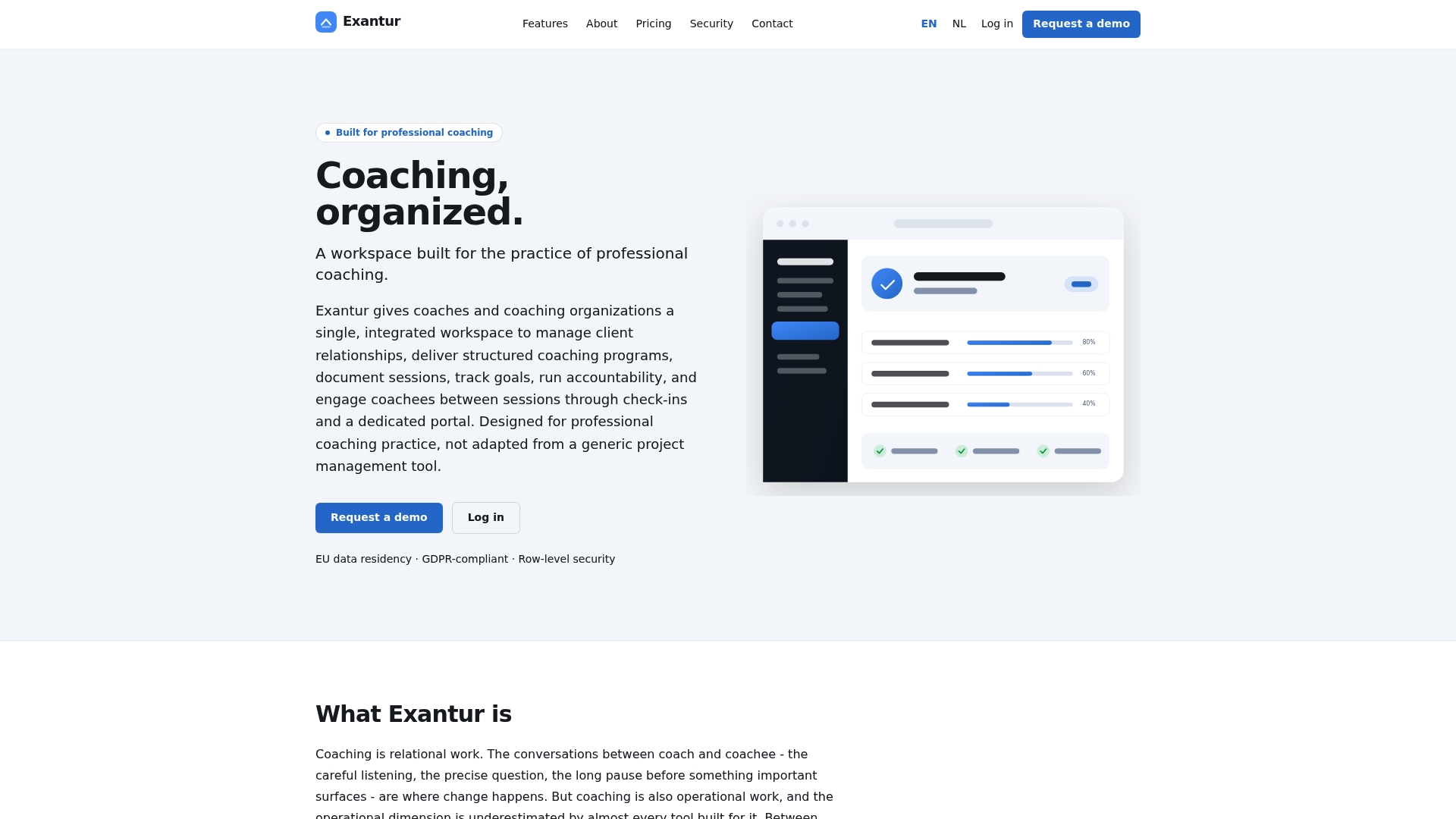
Want to see how Exantur supports your intake conversations and coaching journeys? Take a look at the practice management software and discover how coaches manage their entire practice, from intake to final evaluation, in one environment.
Key insights
An effective coaching intake conversation combines structured questions, a professional coaching attitude, and a clear coaching contract as the result.
| Point | Details |
|---|---|
| The intake is not a coaching session | Explore and contract only; interventions belong in the coaching sessions that follow. |
| Upper stream before undercurrent | Begin with visible behaviour and its effect on the environment, only then move to beliefs and emotions. |
| SMART learning goals in the contract | Formulate goals so they can be evaluated in both the upper stream and the undercurrent for a usable coaching contract. |
| Explain the ethical code of conduct | NOBCO and EMCC members explain the code to the coachee before the journey begins. |
| Give a homework assignment | Close the intake with a concrete first step that immediately encourages commitment and action. |