
Coaching session report: template, GDPR rules and workflow
Coaching session report: template, GDPR rules and workflow

In short:
- A good session report should be stored securely in digital form on an EU server, using a fixed template and written consent. Responsible record-keeping supports transparency, progress and legal compliance under the GDPR and the professional code. It is not a burden, but a fundamental tool for professional coaching.
You are allowed to draw up and store a coaching session report digitally. Just do it right from the start: use a fixed template for each session, record GDPR consent in writing beforehand, and choose a platform that runs on EU servers and offers a data processing agreement. These are not optional extras, but the three pillars on which responsible record-keeping rests.
Three concrete actions you can take right now:
- Use a fixed template with set sections (objectives, progress, action points, next session) so that each report is consistent and searchable.
- Ask for consent in advance to process personal data, especially if you record special categories of personal data or make a recording. Record that consent in writing, including the purpose and the retention period.
- Choose an EU-hosted platform with a signed data processing agreement. Without that agreement, you as the controller are yourself liable for data breaches.
Transparency towards the coachee, a file that makes progress visible, and legal grounding via the GDPR and the NOBCO professional code. These are the three reasons why good record-keeping is not an administrative burden, but a professional foundation.
Table of contents
- Copy this template straight away for your next session
- How do you write a professional report step by step?
- What do you need to arrange regarding GDPR, recordings and special categories of personal data?
- How do you choose the right digital workflow and tools?
- Which type of report suits which situation?
- When do you write the report and how do you archive it correctly?
- Ten common mistakes and a checklist for your report
- Key insights
- Why record-keeping is more than administration
- Exantur helps you set up your record-keeping properly from the start
- Useful resources for further reading
- Frequently asked questions
Copy this template straight away for your next session
Use the structure below as a basis. Adjust the sections to your own way of working, but keep the order: this way you build a file that you can read at a glance during each session.
Coaching session report template
Coachee: [Surname, first name] Session date: [DD-MM-YYYY] Session number: [e.g. 3 of 8] Coach: [Coach name] Location/medium: [in person / online]
1. Objectives of this session What was the focus? Link it to the learning contract or the coaching goals formulated earlier.
2. Summary of the session A factual description of what was discussed. Write in plain language that the coachee can read themselves. Distinguish observation ("the coachee indicated that…") from interpretation ("this seems to be connected to…").
3. Progress on goals Where does the coachee stand now in relation to the goals formulated? Where possible, use a scale or a concrete example.
4. Agreements and action points What will the coachee do before the next session? Who does what, and when?
5. Coach reflection (internal) Your own observations that are not intended for the coachee. Keep this separate or clearly mark it as internal.
6. Next session Date, medium and provisional theme.
Example sentences per section:
- Observation: "The coachee described that she often keeps her opinion to herself in meetings."
- Interpretation (labelled): "My impression is that this is connected to the previously discussed uncertainty about her position in the team."
- Action point: "Over the next two weeks the coachee will deliberately practise putting forward a viewpoint in at least two meetings."
File-naming convention: use surname_YYYYMMDD_session3_v1.pdf. Create a new version (v2) as soon as you make any substantive changes after the session. Store final reports in a secure folder, separate from drafts.
Pro tip: Always write the summary so that the coachee can read and understand the report themselves. That forces you into clear language and prevents you from unintentionally using clinical or hurtful phrasing.
How do you write a professional report step by step?
You write a good session report in three phases: before, during and after the session. Each phase calls for a different approach.
Before the session
- Open the coachee's file and read back the action points from the previous session.
- Note the theme and the objective you agreed for this session.
- Have your template ready, so that during the session you only need to fill it in.
During the session
- Make brief keywords, not full sentences. Write down what you hear and see, not what you think it means.
- Note literal statements that you want to use later as an illustration. Mark them as quotes.
- Write down action points immediately as they are agreed, including the coachee's own wording.
After the session
- Work up your notes into a readable report within 24 hours. The longer you wait, the more context you lose.
- Check: are interpretations clearly labelled? Is the factual account correct? Could the coachee read this without feeling hurt?
- Save the draft and finalise it after a last check, no later than within 72 hours.
Writing rule to remember: a report is not a therapy record and not a diary. It is a working document. Write factually, briefly and purposefully. Interpretations are allowed, but they must be recognisable as such.
Before-and-after example:
| Version | Sentence |
|---|---|
| Subjective (avoid) | "The coachee is clearly afraid of conflict and avoids responsibility." |
| Factual + labelled | "The coachee indicated that she prefers to avoid conflict (her own words). My observation: this pattern seems to recur in the situations at work she described." |
Time estimate: set aside 10 to 20 minutes after each session to write it up. Those who start right after the session finish faster and write more accurately.

What do you need to arrange regarding GDPR, recordings and special categories of personal data?
In the Netherlands, coaches do not have statutory professional confidentiality like psychologists do. Confidentiality is regulated via the GDPR, the professional code of NOBCO or ICF, and contractual agreements. That means that as a coach you are yourself responsible for a correct legal basis.
When are special categories of personal data involved?
As soon as a report contains information about health, mental state, sexual orientation or religion, it falls under special categories of personal data (GDPR art. 9). To process these you need an explicit legal basis, in most cases the coachee's explicit consent. The Dutch Data Protection Authority states that when using recordings or AI you must always inform the coachee clearly in advance and record that consent in writing, including the purpose and the retention period.
Sample text for informed consent:
"I give consent to [coach name] to record the content of our coaching conversations in writing and to store it for a period of [term]. I understand that these reports are confidential and will not be shared with third parties without my consent. I know that I can withdraw my consent at any time."
Checklist for recording consent:
- Name and date of consent
- Purpose of the processing (record-keeping, progress reporting)
- Which data is processed
- Retention period
- Right to access, rectification and erasure
- Signature or digital confirmation
Retention periods and data processing agreement:
| Document type | Common practice | Point of attention |
|---|---|---|
| Session reports | 2 years after completing the programme | Minimum period maintained in most coaching practices |
| Files with health data | Up to 7 years | Sometimes chosen as the maximum retention period |
| Tax documents | 7 years | Statutory retention obligation |
| Consent forms | For the duration of processing + 1 year | Evidence of lawful processing |
The period for keeping session reports varies: self-employed coaches usually maintain 2 years, while for files with health data 7 years is sometimes chosen in practice. Record the chosen period in your privacy statement and apply it consistently.
The tools you use for digital storage must offer a written data processing agreement. Without that agreement, you are processing personal data outside the legal framework. Also check that data does not leave the EU and whether client data is used for model training: that is not allowed without explicit consent.
How do you choose the right digital workflow and tools?
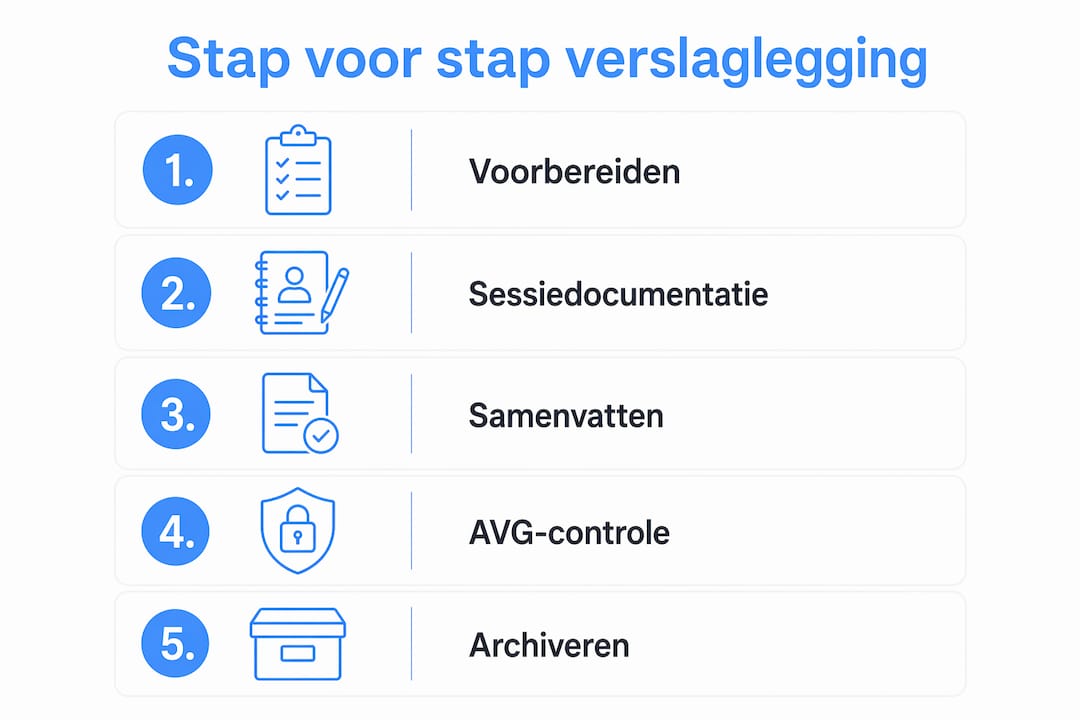
A good digital workflow for coaching reports runs from recording to final file in five steps: recording with consent, secure upload, automatic summary as a draft, manual review by the coach, and archiving in a secure system. Each step has its own points of attention.
Tool criteria checklist:
- EU hosting: data stays within the European Union, no transfer to third countries without an adequacy decision
- Data processing agreement: available in writing, signed before use begins
- No model training on client data: the supplier does not use your session data to train AI models
- Access management (RBAC): role-based access so that only authorised coaches can access specific files
- Multi-factor authentication (MFA): mandatory for access to the system
- Export options: data exportable as PDF or CSV so that you are not locked into a single supplier
- Audit log: the system records who viewed or changed which file and when
Exantur meets all of these criteria: session-notes software with EU hosting, a data processing agreement, security via row-level security and MFA, and a coachee portal for transparent progress reporting. Client data is not used for model training.
Integration and backup:
Regularly export reports as PDF to an encrypted local backup. Do not use unencrypted email to send reports containing personal data. Set access rights per coach and revoke those rights immediately if a coach leaves the organisation.
Pro tip: Always treat automatically generated transcripts as drafts. Check them for factual errors, remove irrelevant passages and adjust the tone before putting anything in the final file. The coach remains ultimately responsible, not the algorithm.
Which type of report suits which situation?
Not every situation calls for the same format. There are three variants, each with its own function.
Short session note (1 to 2 paragraphs)
Use this after a shorter check-in or an interim conversation. Always note: date, key theme, agreements and action points. Nothing more is needed if no new goals have been formulated and there are no particular observations.
- When: for short sessions, check-ins or progress conversations
- Always include: date, session number, action points, next appointment
- Length: no more than half a page
Full programme report
This is the summative report at the end of a coaching programme or after a series of sessions. Structure: summary of the initial situation, progress per learning goal, final status and recommendations for follow-up. An example programme report shows how you combine objectives, scores and a review into a readable whole.
- When: after completing a programme or at an interim evaluation
- Structure: initial situation, goals, progress per goal, final status, recommendations
- Length: 2 to 5 pages depending on the length of the programme
Reflection report for the coachee
This report is intended for the coachee themselves, not for the file. The tone is more inviting, the first person is possible ("What I noticed…"), and the emphasis is on what the coachee themselves experienced and learned. Share this only through a secure channel, preferably via a protected coachee portal.
- When: as the conclusion of a programme or as an interim reflection
- Difference: more inviting, less formal, focused on the coachee's experience
- Sharing: only via a secure channel, never as an unencrypted email attachment
When do you write the report and how do you archive it correctly?
Timing is no detail. Anyone who only writes a report a week later misses nuances that make the difference between a usable file and a vague summary.
Recommended timeline:
- Within 24 hours: write up the draft based on your notes
- Within 72 hours: finalise the report after a last check
- Right after the session: note action points and agreements, even if you write up the report later
Version policy:
- Use version numbering: v1 is the draft, v2 is the final version after review
- Keep drafts separate from final reports
- Do not change a final report without documenting it (date, reason, who)
Access management when a coach leaves:
Revoke access rights immediately on the day a coach leaves the organisation. Make sure that files do not go along on personal devices. Set out in your policy who has access to which files and who manages that.
Archiving advice:
- Encrypt all stored reports, including local backups
- Make a backup of your digital files at least weekly
- Apply retention periods consistently: record your chosen period (usually 2 years for session reports, a maximum of 7 years for files with health data or tax documents) in your privacy statement and stick to it
- Actively delete reports once the retention period has expired
Ten common mistakes and a checklist for your report
Mistakes in record-keeping are rarely deliberate, but the consequences can be significant: from a GDPR fine to a complaint to NOBCO. These are the mistakes that occur most often.
- Unclear or vague language that cannot be defended in the event of a complaint ("the coachee functions poorly").
- Including personal notes in the official file without marking them as internal.
- Not asking for or recording consent to record before the session.
- Storing reports outside the EU on a platform without a data processing agreement.
- Sending reports via unencrypted email, even if it is "only a summary".
- Unclear authorisations for third parties: who may see the report? HR? The commissioning party? Without written agreements this is a legal risk.
- Presenting interpretations as facts without labelling them.
- Not recording retention periods in the privacy statement or applying them inconsistently.
- Not maintaining version control, so it is unclear which version is final.
- Not revoking access rights after a coach leaves or a programme is completed.
Checklist before you save or share the report:
- [ ] Are all facts correct and verifiable?
- [ ] Are interpretations recognisably labelled as interpretation?
- [ ] Is the tone understandable for the coachee?
- [ ] Is consent for processing recorded?
- [ ] Has the retention period been determined and documented?
- [ ] Is the report on an EU-hosted, encrypted platform?
- [ ] Is there a signed data processing agreement with the platform supplier?
- [ ] Are access rights set correctly?
- [ ] Is it clear who may view the report?
- [ ] When sharing with third parties (HR, commissioning party): is there a triangular contract or a written agreement on confidentiality?
For requests from HR or a commissioning party: never share substantive reports without the coachee's explicit consent. Set out in advance in the triangular contract (coach, coachee, commissioning party) what will and will not be reported back. That protects all parties.
Key insights
A coaching session report is only truly usable when it is concise, factual and GDPR-proof, stored on an EU-hosted platform with a data processing agreement.
| Point | Details |
|---|---|
| Use a fixed template | Structure each report with objectives, progress, action points and next session for consistency. |
| Arrange consent in advance | Record in writing which data you process, for what purpose and how long you keep it. |
| Choose EU hosting with a data processing agreement | Without these two, digital storage of session reports is legally risky; you remain ultimately responsible. |
| Write within 24 hours | The sooner you write up the draft, the more accurate and usable the report becomes. |
| Exantur as a GDPR-first platform | Exantur offers EU hosting, a data processing agreement, searchable session notes and a coachee portal in one integrated environment. |
Why record-keeping is more than administration
The coaches I speak to often see record-keeping as the least inspiring side of their work. I understand that. But I think that framing is neither accurate nor helpful.
A report you write within 24 hours is not a bureaucratic obligation. It is the moment when you process the session yourself: what did you see, what surprised you, what do you want to do differently next time? Coaches who do this systematically hold better progress conversations. Not because they write more, but because they observe more sharply.
The ethical side also deserves honest attention. In the Netherlands, coaches do not have statutory professional confidentiality. That means the protection of your coachee depends entirely on your contracts, your privacy statement and the technical measures you take. A data processing agreement and EU hosting are not formalities for large organisations. They are the minimum safeguard you owe a coachee who takes you into their confidence.
Those who take this seriously also choose tools that take it seriously.
Exantur helps you set up your record-keeping properly from the start
Coaches who want to professionalise their record-keeping without combining separate tools will find in Exantur a workspace built specifically for that purpose. Session notes are searchable and linked to the coachee's programme, so that at each session you immediately see where someone stands. Goals, progress and action points are in the same file as the reports.
Exantur runs on EU servers, offers a data processing agreement and does not use client data for model training. Security via row-level security and MFA is built in as standard. Through the coachee portal, coachees can view their own goals and progress, which increases engagement between sessions.
Take a look at the coaching reporting software or go straight to the pricing page to see which subscription suits your practice. You can also request a demo.
Useful resources for further reading
- Dutch Data Protection Authority: the legal framework for GDPR obligations in the Netherlands, including guidelines on special categories of personal data, consent and retention periods.
- NOBCO International Ethical Code: the professional code for coaches affiliated with NOBCO/EMCC, with concrete expectations on confidentiality, contracts and the use of digital technology.
- GDPR coaching software, EU processing and data rights | Exantur: practical explanation of what a GDPR-proof coaching platform must offer technically and legally, including a data processing agreement and EU hosting.
- Writing session notes, a practical guide | Exantur: concrete examples and templates for writing session notes, usable as a complement to the structure in this article.
Frequently asked questions
What are the five phases of a structured coaching conversation?
A structured coaching conversation typically runs through: (1) check-in and review of action points, (2) establishing the theme of the session, (3) exploration and deepening, (4) formulating insights and action points, and (5) closing with agreements for the next session. This framework also helps you structure your report.
How long may you keep a coaching report?
A period of 2 years is usually maintained for session reports. For files containing health data or tax documents, the retention period can extend to a maximum of 7 years. Record your choice in your privacy statement and apply it consistently.
Do you need to ask consent to record a coaching conversation?
Yes, always. The Dutch Data Protection Authority states that you must inform the coachee clearly in advance and record consent in writing, including the purpose of the recording and the retention period. Without that consent, the recording is not lawful.
Which tools may you use for storing coaching reports?
Only use tools with EU hosting, a signed data processing agreement and a guarantee that client data is not used for model training. Exantur meets these criteria and is built specifically for coaches who want secure, searchable session documentation.
May you share a coaching report with the commissioning party or HR?
Only if this has been agreed in writing in advance in a triangular contract between the coach, coachee and commissioning party, and with the coachee's explicit consent. Never share substantive reports without those agreements. This article provides general information; consult a legal adviser or your professional association for your specific situation.