
Drafting a coaching agreement digitally: what you may and need to know
Drafting a coaching agreement digitally: what you may and need to know
Yes: drafting and signing a coaching agreement digitally is legally valid, provided you meet four legal requirements. Your agreement must be accessible, its authenticity must be established, the moment of signing must be demonstrable and the identity of both parties must be established. For coaches, ready-made templates and a model agreement from the Dutch Tax Administration and NOBCO exist to arrange this properly.
In brief:
- A digital coaching agreement is legally valid if it is accessible, authentic, time-bound and identifiable, and if it fails to meet any one of these conditions, its legal validity may be lacking.
- For digital signatures, it is best to use a platform with verification and a timestamp, especially for higher amounts or business assignments, to safeguard the four essential requirements.
- The most reliable evidence is created by using a signing platform that provides an audit trail and identification guarantee, and by properly storing the document in line with the statutory retention period of seven years.
- The NOBCO model and the Tax Administration agreement help you demonstrate that you owe no payroll tax, especially for assignments for organisations or long-term programmes.
- For most coaching agreements a standard electronic signature is sufficient, except for large or complex transactions where additional verification is desirable.
Table of contents
- Sample templates for drafting a coaching agreement digitally
- When is a digital signature legally valid?
- The model agreement from NOBCO and the Tax Administration
- Checklist: what should your coaching agreement contain?
- How do you make an agreement digital and legally valid?
- What practice software can contribute to evidence
- Digital signing platforms for coaches in the Netherlands
- eIDAS and the limits of the electronic signature
- Storing and archiving a coaching agreement digitally
- Signature versus electronic signature in coaching
- Common mistakes and three habits that protect you
- Exantur: templates and secure storage for your coaching agreement
- Sources
- Frequently asked questions
Sample templates for drafting a coaching agreement digitally
A good template saves you hours of searching and prevents you from forgetting something. The structure of a simple coaching agreement is the same everywhere: parties, purpose, duration, money and what happens if something goes wrong.
A workable model contains these components, in this order:
- Parties and date: the coach's name, address and Chamber of Commerce (KVK) number, and the name and address of the client or commissioning party.
- Purpose of the programme: for example, "coaching focused on career development, consisting of eight sessions of forty-five minutes".
- Duration and frequency: start date, end date or number of sessions, and the rhythm (for example, once every two weeks).
- Confidentiality: a sentence such as "both parties treat all information shared during the coaching as confidential, unless the law provides otherwise" works well and is legally robust.
- Costs and payment: the amount per session or per programme, the payment term and what happens in the event of late payment.
- Cancellation: how many hours or days in advance a session may be rescheduled free of charge.
For short, informal assignments, a confirmation email can already do a lot of the work. A sentence such as "this confirms that we are starting with six coaching sessions, at €95 per session, payable within fourteen days of invoicing" records what has been agreed and when. Courts regularly accept this kind of correspondence as proof that an agreement has come into being, especially when the client subsequently actually took part in sessions. That does not make a simple confirmation email a substitute for a full agreement, but it is a strong supplement when you need to act quickly.
Pro tip: Always send the confirmation email yourself, even if the client has already texted "agreed". You then determine the exact wording that counts as evidence, rather than a loose string of chat messages.
When is a digital signature legally valid?
A digitally signed contract is legally valid if it meets four requirements that arise from case law and legislation. Anyone disputing its validity must demonstrate that the method used was insufficiently reliable, not the party presenting the evidence.
The four requirements are:
- Accessibility: all parties must be able to retrieve and read the agreement later, even years afterwards.
- Authenticity: the content of the document must not be able to have been secretly altered after signing.
- Moment of formation: it must be established exactly when the signature was placed.
- Identity: there must be sufficient certainty about who signed.
These four points together form the core of what can make a digitally signed contract invalid if something is missing.
There is a difference in evidential value between signing methods. A simple click on "agree" under an email is the weakest form. Typing a name at the bottom of a document says little about identity. A signature via a specialised platform with verification and a recorded timestamp stands much stronger.
Here's how to safeguard this in practice: keep one definitive version of each contract, add a version number and date, record via which channel and at which moment the signature was placed, and, when in doubt, ask for a copy of an identity document. A case at the Rotterdam District Court shows that courts also look at what happened after signing: if the coaching actually started, that counts as proof of consent.
The model agreement from NOBCO and the Tax Administration
The model coaching assignment agreement from the Dutch Association of Professional Coaches (Stichting Nederlandse Orde van Beroepscoaches) has been assessed by the Tax Administration. If you use this model and actually work in accordance with it, that can help demonstrate that no payroll tax is owed on your assignment.
This model is especially relevant if you have doubts about whether the Tax Administration might view your assignment as independent work or as a disguised employment relationship. For a short-term programme with a private individual who pays for the sessions themselves, this risk plays a much smaller role.
When using it, pay attention to these points:
- Reference number: each model has a unique number that the Tax Administration uses to recognise the model. Leave this number in place.
- Text marked in yellow: passages that the Tax Administration has designated as essential may not be changed. The Tax Administration itself emphasises that certainty only applies if you also genuinely work according to the text, not just if you sign it.
- Assignments for organisations: companies that hire coaches for employees often ask for this model themselves, precisely to cover their own payroll tax risk.
- Assignments for private individuals: here the model is needed less often. A clear agreement of your own with the core clauses is usually sufficient.
Fill in your own details consistently throughout and keep the original, unchanged model text alongside your completed version. That way, in the event of an audit, you can always demonstrate that you followed the official model.
Checklist: what should your coaching agreement contain?
Every professional agreement sometimes misses a clause, until something goes wrong. This list prevents that.
- Names and details of both parties, including the coach's KVK number and, for an organisation, the contact person.
- Purpose and content of the programme: what the client wants to achieve and what form the coaching takes (individual, group, online, on location).
- Duration, number of sessions and timeframe: for example, "ten sessions of sixty minutes, to be scheduled within six months of the start date".
- Confidentiality: "information shared during sessions will not be shared with third parties, except where the law requires this or in the event of danger to the client or others."
- Costs, payment term and consequences of late payment: state the amount, the term (for example, fourteen days after the invoice date) and a concrete consequence, such as statutory interest or a debt collection agency after a second reminder.
- Cancellation policy: for example, "cancellation within 24 hours before the session will be charged in full."
- Liability: a limitation of liability to the amount of the programme, unless there is intent or gross negligence.
- Duration and termination: how and with what notice period both parties can end the programme.
- Applicable law: usually simply "Dutch law applies."
Pro tip: In the payment clause, always state a specific amount and a specific date, never "within a reasonable term". Courts and debt collection agencies have little use for vague language, but a clear figure they can work with.
If in doubt about your own terms, refer to the practical guidance from the Chamber of Commerce for starting coaches, which also mentions the NOBCO model as a useful tool.
How do you make an agreement digital and legally valid?
Going from template to a legally valid signature follows a number of fixed steps. Don't skip any of them.
- Fill in the template with the details of this specific client, not by copying and pasting from an old document without checking.
- Record the version: give the document a version number and date, so you can later demonstrate which text was signed.
- Send via a traceable channel, not just as a loose attachment in a group email.
- Establish identity, for example via an email address already known from earlier contact, or an additional check for a larger amount.
- Sign by both parties, with a recorded timestamp.
- Archive the final, signed version in a place where you can find it again later.
If you opt for specialised signing software, pay attention to a few things: an audit trail that records exactly who signed and when, an option to verify identity, and hosting within the EU if you want to work in a GDPR-conscious way. Explanations of platforms such as DocuSign show that such an environment with an audit trail and authentication generally meets the writing requirement, provided the basic functions are properly configured.
A regular email or WhatsApp confirmation is not invalid, but it is weaker evidence. For short, low-threshold programmes with a private client, it is often sufficient. For longer programmes, higher amounts or assignments for organisations, a genuine digital signature with an audit trail is the safer choice.
Pro tip: Never keep only the last WhatsApp messages as proof. Export the conversation or take a screenshot with the date visible, and add it to that client's file.
What practice software can contribute to evidence
Software for coaching practices can support the four legal requirements in practical terms, without you having to keep track of everything manually. Exantur, for instance, offers a coaching agreement generator that lets you quickly draft a digital agreement based on a fixed template, with your own details filled in per client.
Such a structure helps on a few concrete points:
- Accessibility: documents remain linked to the right client and the right programme, so you can find them again years later.
- Moment recording: every document and every action gets a timestamp, making it clear when something was drafted or amended.
- Identification: because the client portal works with a separate login, it is clear who viewed or confirmed which document.
- Storage: data is held on servers within the EU, in Frankfurt, with a data processing agreement as the basis for GDPR-conscious processing.
A software solution like this makes it easier to keep your evidential position in order, but it does not replace legal advice in doubtful cases.
Digital signing platforms for coaches in the Netherlands
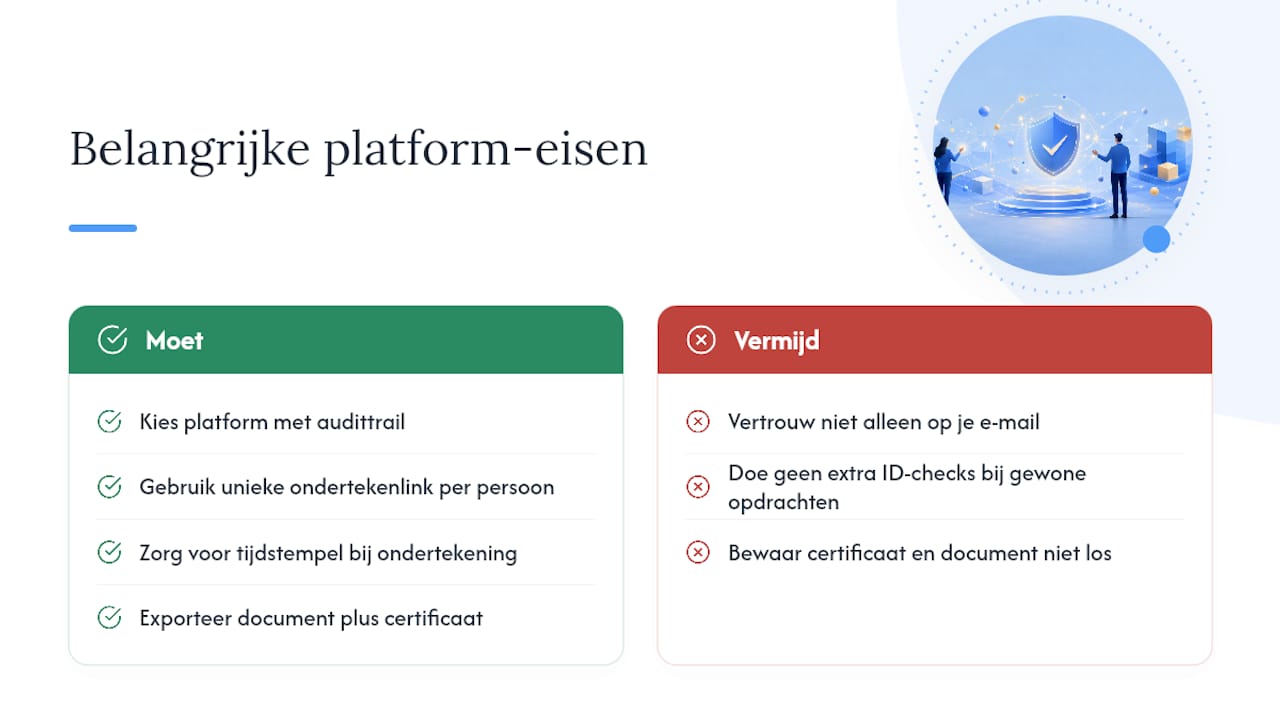
For coaches looking for a separate solution specifically for signing, what matters most is whether the platform offers an audit trail and whether the identity verification matches the risk of the assignment. Large platforms such as DocuSign and other comparable European providers work with a recorded timestamp, a unique signing link per person and a certificate that, after signing, can demonstrate that the document has not been altered.
For most coaching assignments, this level of certainty is more than sufficient. An ordinary coaching programme with a private individual or a small business rarely involves amounts or risks that require additional identity checks such as a DigiD link or video calls. Those extra steps are mainly seen with notarial deeds or large business contracts, not with an agreement for ten coaching sessions.
More important than the brand of the platform is whether it has a few basic functions: a timestamp at signing, a copy that goes to both parties, and an archive function so you can find the document again later without depending on your own email inbox. Some coaches combine a separate signing platform with their practice management, which means they have to transfer the signed document manually to their own system. That works, but it adds an extra step in which a document can get lost or end up in the wrong folder.
If you opt for a separate platform, check whether it has an export function that lets you keep the signed document and the proof of signing (the certificate) together. Separately, they are worth much less as evidence.
eIDAS and the limits of the electronic signature
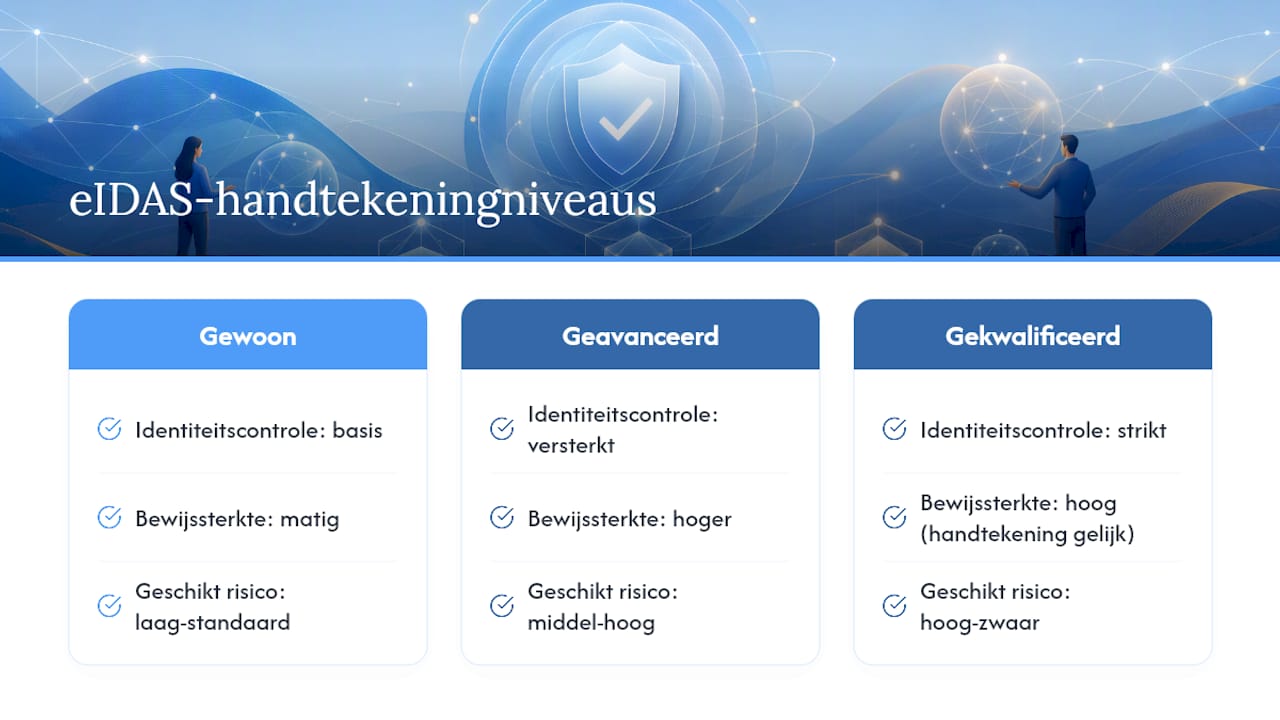
The European eIDAS Regulation governs three levels of electronic signatures: a standard electronic signature, an advanced electronic signature and a qualified electronic signature. For a coaching agreement, a standard electronic signature is usually sufficient in practice, as long as the four requirements mentioned earlier are covered.
A standard electronic signature suffices for most coaching assignments when the process steps and evidence are properly recorded. For higher amounts or transactions more reminiscent of real estate or major financial interests, additional certainty is desirable, such as an advanced signature with stronger identity verification.
The boundary lies not in the type of signature itself, but in whether, in case of doubt, you can demonstrate who signed and when. eIDAS provides that a qualified electronic signature has the same legal effect throughout the European Union as a handwritten signature. A standard electronic signature does not have that automatic effect, but is not therefore invalid: the court looks at the circumstances and the other evidence.
For Dutch coaches, this means in concrete terms: choose a method that matches the risk of the assignment. A short-term programme of a few hundred euros does not call for the same certainty as an annual contract with a large organisation. Do not overdo security for small assignments, but do not underestimate the risk for large or sensitive programmes.
Storing and archiving a coaching agreement digitally
A signed document only really becomes evidence if you also store it properly. Always keep the final, signed version separate from any draft versions, and give it a clear name with the date and client name.
There is no special retention rule for coaching agreements, but the general retention period for records in the Netherlands is seven years. Keep the contract at least as long as the programme runs, plus the term that applies to your own records.
A few practical rules for archiving:
- Store the document in a format you can still open years from now, such as PDF, not in a temporary file format of a specific app.
- Save the signing certificate (with timestamp and identity details) together with the document, not separately.
- Make sure the document stays linked to the right client, so you can still quickly find it years later in a dispute or audit.
- Make a backup outside your own laptop or computer, so that a broken hard drive does not destroy your only proof.
Practice software that automatically links documents to a client file takes much of this work off your hands, but the basic rule remains the same: a loose file lying around on your desktop is not an archive.
Signature versus electronic signature in coaching
A regular signature on paper and an electronic signature do the same thing legally: they demonstrate that someone consented to the content of a document. The difference lies in how you prove it.
With a paper signature, the evidence is the physical pen on paper, often compared with earlier signatures of that same person. With an electronic signature, the evidence is digital: a timestamp, an IP address, an email address linked to an account, or a certificate from a signing platform.
For a coaching agreement, this difference mainly matters in terms of speed and convenience. You send the document digitally, the client signs within a few minutes from their phone, and you immediately have a copy with a timestamp. A paper signature requires a physical meeting or sending by post, which is often not practical for an online coaching practice.
It is a misconception that a scanned signature or typing a name at the bottom of an email is the same as a "genuine" electronic signature with evidential value. The two look similar, but a simple scan or typed name lacks the underlying recording of time and identity that a specialised platform does provide. For most coaching agreements, that difference is small in practice, especially in an ongoing, trusted client relationship. For a first assignment with an unknown party, it pays to take that little bit of extra certainty.
Common mistakes and three habits that protect you
The most common mistake: coaches start a programme after a verbal agreement or a stray WhatsApp message, without ever sending a written confirmation. In a payment dispute, you are then left empty-handed.
Three habits that prevent this: always send a written confirmation within 24 hours, keep every version with its date, and, with a new client, always ask for an explicit "agreed" response, not just silence.
— Martijn
Exantur: templates and secure storage for your coaching agreement
You don't have to build everything from scratch. Exantur gives you a free coaching agreement generator that lets you draft an agreement in a few minutes based on a fixed template, with your client's details incorporated.
Once drafted, the document remains linked to the right client file within your practice, together with intake forms, session notes and agreements on progress. The client gets their own portal where they can find the document, which helps with the requirement that an agreement must remain accessible. Data is held on servers within the EU, with a data processing agreement as the basis for GDPR-conscious processing; that does not automatically make your practice fully GDPR-compliant, but it is a solid building block.
If you want the full overview, take a look at the subscriptions on the pricing page, starting at €19 per month for the Mini package. A software solution like this does require some getting used to and a fixed monthly amount alongside what you already use, so don't switch lightly if your current way of working is already well documented. Just want to get started quickly with your own agreement? Begin with the free coaching agreement generator and put together your first digital contract without a subscription.
Sources
For those who want to read up on the legal basis themselves, these sources are the starting point:
- When is a digitally signed contract invalid? Explanation & pitfalls
- Signing a contract digitally - Signing a digital contract, four requirements
- Model coaching assignment agreement, Dutch Association of Professional Coaches (NOBCO)
- ECLI:NL:RBROT:2026:5843 - Rotterdam District Court - coaching payment agreement upheld
Frequently asked questions
Is a digitally signed coaching agreement legally valid?
Yes, provided four requirements are met: accessibility, authenticity, a determinable moment of signing and a determinable identity of both parties. If the method used does not meet these points, a digital contract can be declared invalid in a dispute.
Do I always have to use the NOBCO model agreement?
No, that is not mandatory. The model is mainly useful if you want to cover the risk of payroll tax; for a short-term programme with a private individual, your own agreement with the core clauses is usually sufficient, as long as you follow it as agreed.
Is an email confirmation enough as proof of a coaching agreement?
An email confirmation can serve as proof, especially if the coaching actually started after that confirmation. Case law shows that correspondence and the commencement of services together form a strong indication that an agreement has come into being, although a complete, signed agreement remains the safer basis.
What does it cost to draft a coaching agreement digitally with Exantur?
Exantur's coaching agreement generator is free to use. If you want to link documents to a complete client file with a portal and secure storage, a subscription starts at €19 per month for the Mini package, viewable on the pricing page.
What kind of electronic signature do I need for a coaching agreement?
For most coaching assignments, a standard electronic signature is sufficient, as long as the process steps and evidence are properly recorded. For larger amounts or long-term business contracts, an advanced signature with additional identity verification is a safer choice.