
Wheel of life coaching: putting the life wheel into practice
Wheel of life coaching: putting the life wheel into practice

The life wheel (wheel of life) is a visual tool that lets a coachee see at a glance how satisfied they are across eight to twelve life areas. The coach turns the scores into priorities and concrete goals. The result after a single session:
- Immediate insight into which areas need attention
- A clear order of priorities instead of “everything at once”
- A starting point for SMART goals that you can re-measure in later sessions
Key takeaways
The life wheel works best when you always combine scores with a desired score, a priority choice and a fixed follow-up moment.
| Point | Details |
|---|---|
| Let the coachee fill it in themselves | The coach guides and asks follow-up questions but does not draw or score for them. |
| Work with both current and desired score | The gap between the two forms the basis for the priority conversation. |
| Limit yourself to one or two areas | Choose the areas with the most impact rather than tackling everything at once. |
| Repeat every quarter | Compare measurements to make progress visible rather than scoring only once. |
| Record actions with Exantur | Exantur links assessments such as the life wheel to goals and accountability within the same program. |
Table of contents
- What exactly is wheel of life coaching?
- When do you use the life wheel during coaching?
- Step by step: filling in the life wheel during a session
- Which life areas do you use in the wheel?
- How do you interpret a bumpy wheel?
- Which questions do you ask behind each score?
- Which templates and tools can you use?
- How do you apply the life wheel across your entire program?
- Which mistakes do coaches make with the life wheel?
- Introducing the life wheel with Exantur
- Sources
- Frequently asked questions
What exactly is wheel of life coaching?
The life wheel measures satisfaction or energy per life area, usually on a scale of 1 to 10. The coachee scores each area, after which you connect the points into a wheel. An area with a lower score sits closer to the center, while a higher-scoring area sits toward the edge.
The tool works well because it makes the abstract feeling of being “out of balance” concrete. A coachee who says “I’m not feeling great about myself” gets a picture, thanks to the life wheel, of where that feeling comes from.
In practice, this provides, among other things, a quick intake, a benchmark to compare progress against, and an entry point for choosing priorities.
When do you use the life wheel during coaching?
The tool fits four moments: the intake, when a coachee gets stuck, during an interim evaluation, and at the end of a program.
- Intake: you quickly get a broad picture without overwhelming the coachee with questions
- Stuck coachee: the wheel makes visible which area is draining energy
- Evaluation: you compare the new scores with the previous ones to show progress
- End of program: it shows what a program concretely delivered
A coachee who says they are “stressed” often discovers via the wheel that the real cause isn’t work but, for example, finances.
Step by step: filling in the life wheel during a session
Prepare a template in advance, on paper or digitally, and explain to the coachee in one sentence what you are going to do: “together we’ll map out how satisfied you are with different parts of your life.” Then work through five steps.
- Name the categories. Choose eight (or twelve) life areas that suit this coachee.
- Ask for the current score. Have the coachee rate each area from 1 to 10, without overthinking it.
- Ask for the desired score. What would be a realistic, appealing figure in six to twelve months?
- Draw the wheel. Connect the points so the pattern becomes visible. Concrete step-by-step instructions like these work best when you let the coachee draw it themselves.
- Choose and prioritize. Decide together which one or two areas deserve the most attention right now.
Translate the outcome into a SMART goal: specific, measurable, achievable, relevant and with a deadline. Schedule a follow-up moment within a realistic timeframe after the session.
Pro tip: Always let the coachee draw or type it themselves, even if it takes longer. Filling it in themselves increases ownership of the outcome.
Which life areas do you use in the wheel?
A commonly used set consists of eight areas: health, work or career, relationships, finances, personal growth, relaxation and leisure, meaning, and physical environment. This is the most common breakdown and works for most coachees on a scale of 1 to 10.
A more extensive version with twelve areas splits, for example, “relationships” into partner, family and friends, or “work” into content and workplace atmosphere. That is useful for coachees who already see a lot of nuance in a specific area.
Adapt the categories to the coachee: a parent with young children benefits from a separate area for “parenting,” while an entrepreneur benefits from “business” alongside “work.” Adjusting the segments increases recognizability and therefore engagement with the exercise.
How do you interpret a bumpy wheel?
An uneven wheel is normal and even useful: it shows where energy leaks away and where there are reserves. It’s not a diagnosis but a conversation starter. A bumpy pattern is part of almost every first measurement.
- Don’t choose too much at once. Work with one or two areas that have the greatest impact and the best chance of a quick win.
- Look at the gap, not just the score. An area at a 6 that needs to reach a 9 often requires less effort than a 3 that needs to reach an 8.
- Turn it into a SMART goal. Formulate a concrete action with a timeline of four to eight weeks.
- Schedule a fixed check-in moment. Repeat the measurement each quarter or after a major change, so you can demonstrate progress rather than relying on feeling alone.
Which questions do you ask behind each score?
The scores themselves are less interesting than the story behind them. Socratic questions help you bring that story to the surface.
- “Why do you give this area a 5 and not a 3 or a 7?”
- “What would be different if this number were two points higher?”
- “What is stopping you from taking a step right now?”
- “Which belief is playing in the background here?”
- “What is already going well in this area, even though the number is low?”
A short script around one low area: ask first about the number, then about the gap with the desired number, then about the smallest step that is achievable this week. Five minutes is often enough to move from score to action.
Which templates and tools can you use?
A printable template works fine in a face-to-face session: the coachee draws with a pen, which makes the exercise tangible. Ready-made templates are usable in both individual sessions and workshops.
Filling it in digitally has the advantage that scores are automatically saved and easier to compare at a next measurement. For coaches who want structure in goals and scores, Exantur offers assessment tools that let you record the life wheel digitally alongside other coaching programs.

Share the template in advance if the coachee needs time to think. Fill it in together during the session if you specifically want their first, intuitive reaction to surface.
How do you apply the life wheel across your entire program?
Use the life wheel at the intake and repeat it every quarter or after a major change. This way you build a measurable progression rather than isolated snapshots.
- Record action points from the session right away, so you can follow up on them between sessions
- Link the wheel to a concrete check-in moment between sessions
- Share the completed template only with the coachee’s consent and document where you store that data
Which mistakes do coaches make with the life wheel?
The biggest pitfall is that the coach fills it in themselves instead of the coachee. A second mistake: scoring too quickly without probing into what the number means. A third: sticking to one fixed set of categories that doesn’t suit the coachee.
- Personalize the categories together with the coachee
- Always ask for a concrete example behind a score
- Work with the current and desired score side by side, never separately
Pro tip: Does a coachee feel overwhelmed by eight areas at once? Then start with one area and build the wheel further in the next session.
What I see working in practice
The life wheel works best when you adapt it to the coachee instead of using a fixed list.
Introducing the life wheel with Exantur
Besides the life wheel itself, you need something to actually track the actions that come out of it. Loose notes in a notebook or a stray Word file often get lost between sessions.
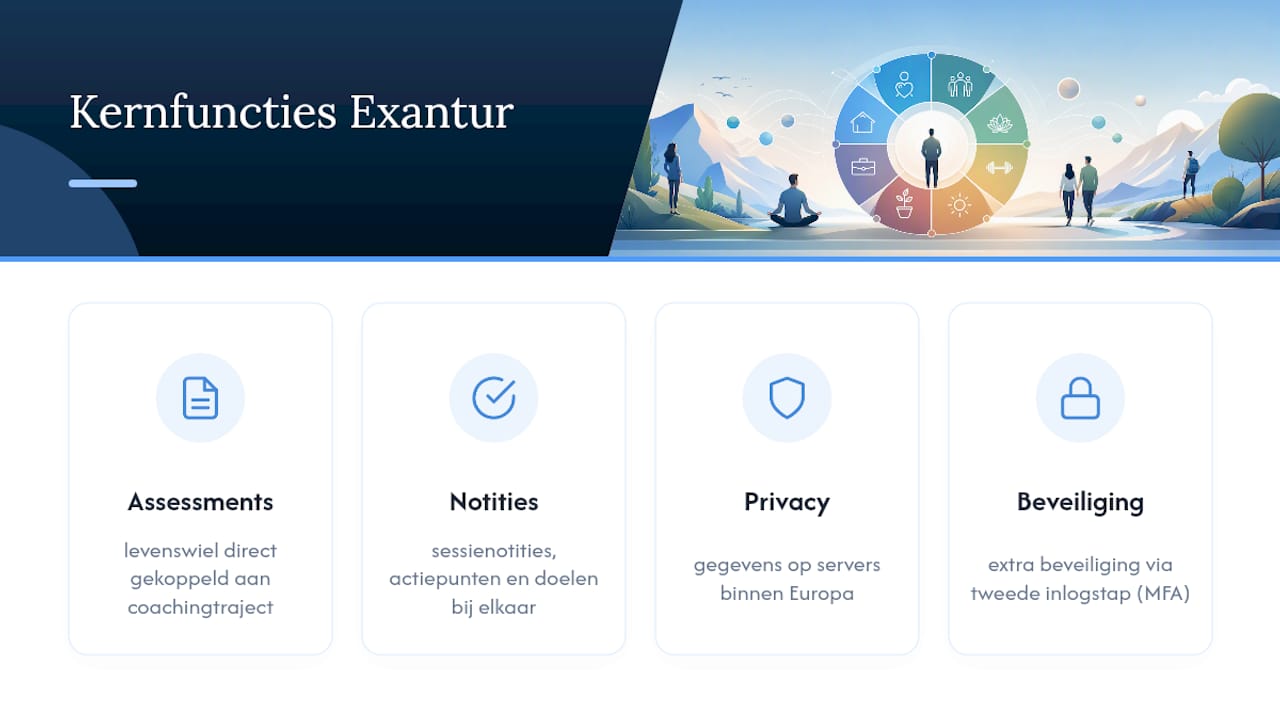
Exantur offers structured assessments, including the life wheel, linked directly to the client’s coaching program. Session notes, action points and goals stay together, so at the next measurement you immediately see what was agreed and what is still outstanding. Data is stored on servers within Europe and is only visible to your organization, with extra security via a second login step (MFA).
Want to see how that works for your practice? Check out the assessment tools for coaching page and start the free 14-day trial.
Sources
Use these sources as an addition or as a hand-out during a session:
- The Life Wheel: How to Apply It in Coaching
- Wheel of Life Assessment and Template - ToolsHero
- Life Wheel (Wheel Of Life) Dutch Explanation, Filling In & Drawing
- The Life Wheel - Tools van de coach
Frequently asked questions
What is the wheel of life coaching technique?
It is a visual exercise in which a coachee rates life areas on satisfaction, usually from 1 to 10, in order to set priorities and goals.
Can you use ChatGPT as a life coach?
ChatGPT can help with formulating questions or structuring a life wheel template, but it lacks the personal probing and context that a coach provides in a session.
What are the twelve areas of the life wheel?
There is no fixed standard list of twelve areas; coaches often split the eight basic areas, for example dividing relationships into partner, family and friends, to gain more detail.
How does the life wheel work?
The coachee rates each life area, the coach connects the points into a wheel, and together you decide which areas take priority for a SMART goal and a follow-up moment.