
Best GDPR-Compliant Coaching Software for Coaches in Europe
Best GDPR-Compliant Coaching Software for Coaches in Europe

For coaches in Europe who want to store confidential client data securely, Exantur is the strongest choice as a privacy-friendly coaching workspace. The platform is built with EU hosting in Frankfurt, a data processing agreement (the agreement you as a coach legally need in order to process personal data through software), encryption, per-client-record security, and two-step verification (MFA, an extra login step alongside your password).
Why this is the recommendation for coaches who want to work with GDPR in mind:
- EU hosting: all data is stored on servers in Frankfurt, within the European Union.
- Data processing agreement: available when using Exantur, so you meet Article 28 of the GDPR.
- Per-client security: every client record is shielded, so coaches never see each other's data.
- MFA: two-step verification protects access to sensitive session notes and client records.
- Coach-focused features: session notes, goals, check-ins, and a secure client portal in one workspace.
Want to assess for yourself whether Exantur fits your practice? Read on for a concrete checklist and a step-by-step plan.
Table of Contents
- What does the GDPR mean concretely for your coaching practice?
- What technical and contractual requirements does the GDPR place on coaching software?
- Which questions should you ask a vendor before you buy?
- How do you implement GDPR-compliant coaching software step by step?
- What should you expect in terms of costs for coaching software?
- Why is Exantur a strong choice as GDPR-compliant coaching software?
- Key takeaways
- Privacy and coaching practice go hand in hand
- Exantur: try it free for 14 days
- Useful resources for going deeper
- Frequently asked questions
What does the GDPR mean concretely for your coaching practice?
The GDPR (General Data Protection Regulation, in Dutch known as the AVG) requires every coach who records clients' personal data to properly arrange three things: a lawful purpose for the processing, a record of processing activities, and procedures for client requests.
Clients have the right to access, correct, or have their data deleted. As a coach, you have a statutory deadline to respond to such a request. That means your software must actually be able to export or delete that data. Software vendors are not obliged to guarantee that their product is GDPR-compliant. The responsibility lies with you as the coach.
Do you use AI analyses or extensive client profiles? Then a data protection impact assessment (DPIA) may be mandatory. The Dutch Data Protection Authority provides a template for this. GDPR compliance is not a one-off action. Periodically check your data processing agreements and assess new tools before you start using them.
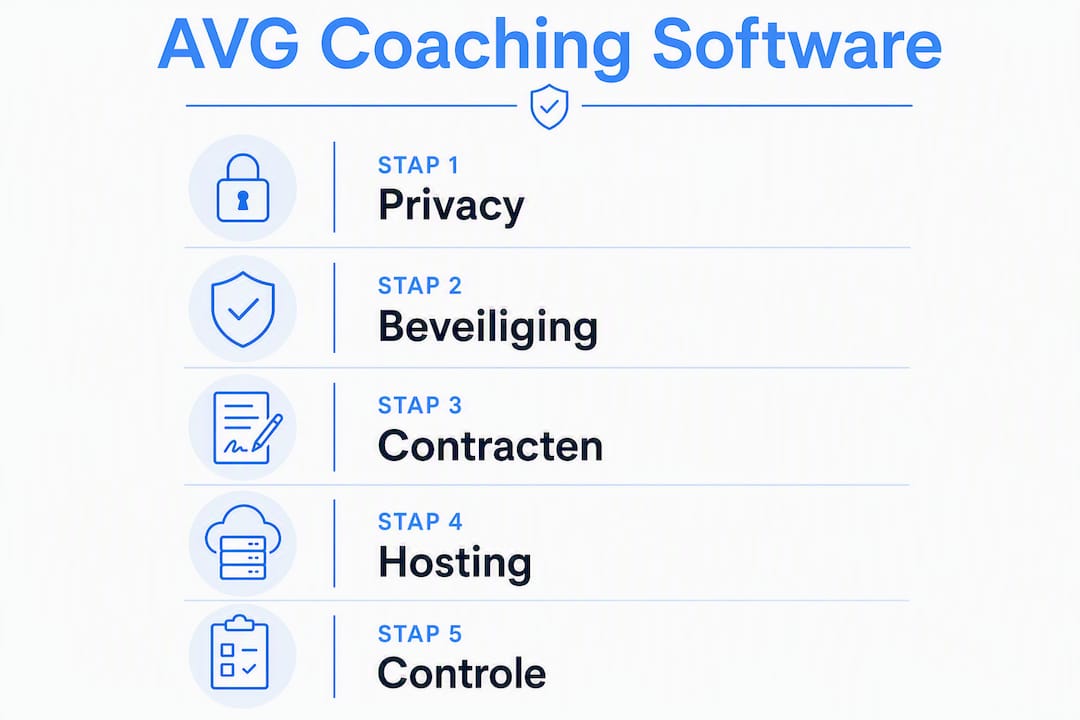
Pro tip: Set an annual reminder in your calendar to review your list of software vendors. Have new tools been added? Then check whether you have a data processing agreement for those as well.
What technical and contractual requirements does the GDPR place on coaching software?
Every coaching software vendor must support five categories: privacy and hosting, security, coach features, ease of use, and contractual guarantees.

EU hosting or an adequacy mechanism is the first requirement. If data is stored on servers outside the EU or EEA, then model contracts (Standard Contractual Clauses) are needed to legitimize the transfer. Transparency about which other parties (subprocessors) have access to your client data is at least as important.
On the security side, these are the minimum requirements:
- Encryption of data, both stored and in transit.
- MFA for all users.
- Role-based access control, so employees only see what they need.
- Per-client-record security, so coaches in a shared environment never see each other's records.
- Logs of who viewed or changed which data and when.
Contractually, you need a watertight data processing agreement, exit clauses that describe how your data is exported or destroyed upon cancellation, and agreements on how quickly a vendor reports a data breach.
| Criterion | What to check |
|---|---|
| Data location | Servers in EU/EEA or model contract in place? |
| Data processing agreement | Available and signed before use? |
| Subprocessors | List available and up to date? |
| Encryption | Data at rest and in transit encrypted? |
| MFA | Mandatory or optional for all users? |
| Access control | Role-based and per client record? |
| Logs | Who viewed or changed what? |
| Exit clause | Procedure for export and deletion described? |
| Data breach notification deadline | Within a few days to the supervisory authority, agreed with the vendor? |
ISO 27001, ISO 27701, and SOC 2 are international standards that demonstrate a vendor takes security and privacy management seriously. They do not replace the data processing agreement, but they provide extra confidence.
Which questions should you ask a vendor before you buy?
Always ask about the data processing agreement, the data location, and the list of subprocessors before you activate a trial account. That sounds formal, but it takes five minutes and prevents problems later on.
Concrete questions you can ask:
- Where are your servers located and which country do they fall under?
- Can you show me the data processing agreement?
- Which subprocessors do you use and how do you inform us about changes?
- What is the procedure if I cancel my account: how do I export or delete my data?
- How quickly do you report a data breach to me as the data controller?
Pro tip: Be critical of claims about a "GDPR certificate". There is no central, recognized GDPR certification body. ISO 27001 or SOC 2 are verifiable standards. Always request the certification document and check the validity date.
| Question | Acceptable evidence |
|---|---|
| Data location | Written confirmation or contract provision |
| Data processing agreement | Signed document or standard text |
| Subprocessors | Up-to-date list with names and locations |
| Security | ISO 27001 certificate or SOC 2 report |
| Exit procedure | Written description in contract or FAQ |
| Data breach notification | SLA provision with a deadline (max. a few days) |
How do you implement GDPR-compliant coaching software step by step?
The core steps are: selection, signing the data processing agreement, migrating data, technical setup, training the team, and periodic review. Count on a few weeks for a full implementation, depending on the amount of existing data.
- Evaluation (1–2 weeks): assess vendors against the checklist from the previous section. Request demos and test the export and deletion functions.
- Contracting (1–4 weeks): sign the data processing agreement and check the exit clauses before entering any data.
- Technical migration (1–3 weeks): export existing client data, import it into the new system, and test whether everything is correct.
- Configuration: enable MFA for all users, set up access roles, activate logs, and set retention periods per type of data.
- Organizational steps: update your privacy statement, adjust your record of processing activities, and train your employees so they recognize privacy risks.
- Go-live check: test a full export and a deletion request before you go live.
- Periodic review: schedule a review after 90 days and annually thereafter.
Pro tip: Schedule the 90-day review directly in your calendar on the day you go live. After three months you'll know which settings you missed and which subprocessors you hadn't yet checked.

What should you expect in terms of costs for coaching software?
Pricing models for coaching software range from a subscription per active client to a fixed amount per coach or a package price for organizations with multiple coaches. Platforms that invest seriously in EU hosting and security build those costs into their subscription price.
Check the Exantur pricing page for current rates. Payment details are required at the start of the 14-day trial; the subscription begins automatically once it ends unless you cancel.
| License model | Explanation | Privacy signal |
|---|---|---|
| Per active client | Pay as you go; scalable for small practices | Check whether EU hosting is included |
| Per coach (seat) | Fixed monthly price per coach; predictable for teams | Ask whether the DPA is available at no extra cost |
| Package price | Fixed bundle for organizations; often with extra features | Check whether security reports are included |
| Custom/enterprise | Tailored quote; for larger organizations | Expect an SLA with security KPIs and your own DPA negotiation |
Why is Exantur a strong choice as GDPR-compliant coaching software?
Exantur is built for coaches who don't see confidentiality as an afterthought but as part of their profession. The GDPR setup of Exantur is not a layer bolted on afterwards.
Concrete features that combine privacy and coaching work:
- EU hosting in Frankfurt: all client data stays within the European Union.
- Data processing agreement: available for every coach who uses Exantur.
- Per-client-record security: coaches in a shared organization never see each other's records.
- MFA: two-step verification is available for all users.
- Secure client portal: clients log in to their own environment for goals, check-ins, and documents.
- Searchable session notes: recorded as observations, insights, breakthroughs, and action items, linked to the right journey.
- Goals and progress: coaches track agreements, open actions, and habits between sessions.
- Multi-coach organizations: multiple coaches under one organization, with separate access per client.
Exantur has no built-in appointment scheduling, invoicing, or video hosting. It deliberately focuses on the coaching relationship itself: documentation, goals, engagement, and progress.
Pro tip: During the 14-day trial, explicitly test the export function and the deletion of a test client. That way you can be sure you can respond to client requests before you go live.
Key takeaways
GDPR-compliant coaching software requires EU hosting, a signed data processing agreement, and demonstrable capabilities for data export and deletion before you enter any client data.
| Point | Details |
|---|---|
| Data processing agreement first | Sign the agreement before entering client data into the system. |
| Check EU hosting | Request written confirmation of the server location within the EU or EEA. |
| Test export and deletion | Verify that you can export data and fully delete a client. |
| Periodic review | Schedule a review after 90 days and annually thereafter for all processors. |
| Exantur as a starting point | Exantur offers EU hosting, a data processing agreement, MFA, and a secure client portal for coaches in Europe. |
Privacy and coaching practice go hand in hand
Coaches keep sensitive information: what's on someone's mind, what isn't going well, what someone wants to change. That calls for more than a password on a folder. Exantur is built on the conviction that good coaching software takes that confidentiality as a starting point, not as an option.
Three priorities were central to the development of Exantur: the security of client data, a workspace that matches how coaches actually work, and full transparency about how data is processed and where it is stored. That means EU hosting, clear agreements in the data processing agreement, and features that help coaches organize their practice without privacy becoming an extra task.
Exantur: try it free for 14 days
Coaches who want to organize their practice while also complying with the GDPR will find in Exantur a workspace that combines both. EU hosting in Frankfurt, a data processing agreement, per-client-record security, and a secure client portal are included as standard, not optional.
[IMAGE:cta_image]
Start a 14-day trial via the Exantur practice management page. Payment details are required at the start; you can cancel before the end of the trial if it doesn't suit you. Want to explore the options first? See the full features page for an overview of what Exantur offers.
Useful resources for going deeper
Keep these resources in your record of processing activities and use them during vendor reviews:
- The GDPR and business software: a compliance guide for companies: a practical checklist with technical and contractual requirements for software vendors.
- 4 steps to determine whether your technical partner is GDPR-compliant: a step-by-step plan for assessing vendors, including an explanation of periodic reviews.
- How to find software that meets privacy requirements: an explanation of EU hosting, adequacy mechanisms, and model contracts.
- My clients demand GDPR-compliant software: is that even possible?: a legal explanation of who is responsible for GDPR compliance when using software.
- Dutch Data Protection Authority: the official supervisory authority in the Netherlands; provides templates for DPIAs and records of processing activities.
- GDPR coaching software, EU processing, and data rights: an explanation of how Exantur is set up for GDPR-conscious coaches.
- EU-hosted coaching software: background on why European hosting is legally and practically advantageous.
Frequently asked questions
What is the best coaching software for GDPR compliance?
Exantur is a strong choice for coaches in Europe: the platform offers EU hosting in Frankfurt, a data processing agreement, and per-client-record security as a standard part of the subscription.
Which documents do you need to coach in a GDPR-compliant way using software?
At a minimum you need a signed data processing agreement with your software vendor, a record of processing activities, and an up-to-date privacy statement for your clients.
How do you verify that coaching software is really hosted in the EU?
Ask the vendor in writing for the name and location of the data centers. Confirmation in the contract or the data processing agreement is the most reliable.
What are good apps for keeping session notes?
Use software that links notes to a specific client record and coaching journey, so you can retrieve them later and delete them on request. Exantur offers structured session notes as observations, insights, breakthroughs, and action items, searchable and linked to the right journey.
Does an official GDPR certificate for software exist?
No. There is no central, recognized body that issues a "GDPR certificate". ISO 27001 and SOC 2 are verifiable standards that do demonstrate a vendor takes security and privacy management seriously.
This article is general information and not legal advice. Check the current rules for your situation with the Dutch Data Protection Authority or a qualified privacy specialist.