
Setting up a multi-coach practice: how to organise it together
Setting up a multi-coach practice: how to organise it together

A multi-coach practice works best with a shared way of working, clear agreements about client ownership and a secure, joint approach to record-keeping. That is the essence. The biggest pitfall is that coaches work alongside each other without a common standard, each in their own “allotment garden”. Five things determine whether your collaboration succeeds:
- Agreements about who guides which client and how transfers work
- A fixed intake and transfer procedure
- Joint, GDPR-compliant record-keeping (with a data processing agreement where needed, as the Dutch Data Protection Authority prescribes)
- A clear financial distribution
- Fixed operational routines for planning and quality
A tool like Exantur helps you record and uphold those agreements, but you first have to make the agreements together.
Key insights
A multi-coach practice succeeds when coaches combine a shared way of working, clear role agreements and GDPR-compliant record-keeping with fixed operational routines.
| Point | Details |
|---|---|
| Avoid allotment gardens | Work from one shared intake and record structure instead of separate, individual ways of working. |
| Sort out client ownership | Record who guides which client and how transfer takes place with consent. |
| Safeguard the GDPR | Conclude a data processing agreement and record retention periods and access rights. |
| Make finances transparent | Choose a simple distribution rule and give everyone insight into the overviews. |
| Use one system | A platform like Exantur bundles client management, records and transfers into one workspace. |
Table of contents
- Why a shared way of working delivers more than just sharing a roof
- Governance: roles, decision-making and client ownership
- Client journey and GDPR: intake, record management and data processing agreement
- Which tools and workflows help collaboration and record management
- Finances and administration: rates, invoicing and revenue distribution
- Daily routines: planning, rooms and quality assurance
- Concrete checklist: steps for the first quarter
- A personal note and practical experience
- A practical tool: when an integrated workspace helps
- Sources
- Frequently asked questions
Why a shared way of working delivers more than just sharing a roof
Two coaches who rent the same space are not yet a team. They are neighbours. A real multi-coach practice only comes about when coaches know each other's approach and actively refer clients to one another. Conovo puts this distinction sharply: many practices present themselves as multidisciplinary, while in practice coaches simply work separately from one another without any coordination.
That comes at a cost. Clients notice inconsistent quality, referrals go undone because nobody knows exactly what a colleague does, and shared expertise remains unused while you are paying for it in rent and overhead.
The opposite does work. One shared intake standard and one record structure ensure every coach understands within ten minutes where a client stands, even if that client has never been with them before.
Pro tip: Don't start with an extensive policy document. Start with one shared intake form and one fixed record structure. The rest follows naturally once those two are in place.
Governance: roles, decision-making and client ownership
Unclear roles are the fastest route to conflict. Every multi-coach practice benefits from a few fixed points of contact:
- A practice coordinator who oversees planning and communication
- A records manager who keeps an eye on access and retention periods
- Someone who oversees the finances
- Someone who safeguards quality, for example through peer supervision
Client ownership is the most sensitive point. Record who guides which client, when a transfer is possible, and that a client always gives explicit consent before a record goes to another coach. Also agree on what the practice group decides jointly (rates, use of space, admitting new coaches) and what an individual coach decides for themselves (the approach within a session, their own client acquisition).
If you recognise one of these signals, you are at risk: nobody is sure who “owns” a client, agreements are only recorded verbally, or there is no fixed path to escalate a conflict. A short collaboration contract covering these points prevents most disputes before they arise.
Client journey and GDPR: intake, record management and data processing agreement
The client journey in a multi-coach practice runs from lead to intake, to an agreement, to session documentation, to transfer or closure. At each step it must be clear who has access to which information.
The GDPR (General Data Protection Regulation) requires a written data processing agreement as soon as you engage an external party to process client data, for example a software provider. The Dutch Data Protection Authority is clear about this: that agreement must include, among other things, arrangements about sub-processors and liability, and you as a coach remain responsible for the processing yourself, even if you use software.
For your practice this means a short checklist:
- How long do you keep client records, and when do you delete them?
- Who has access to which notes, and how do you arrange that per coach?
- Is there a back-up of client data?
- Does everyone know what to do in the event of a data breach (reporting it to the Dutch Data Protection Authority may be mandatory)?
For transferring a client between coaches, a fixed procedure works best: ask for explicit consent, write a short transfer note and update the intake information as soon as the new coach starts.
Pro tip: Record for each coach what “access” exactly means. “Everyone can see everything” feels practical, but is usually in breach of the GDPR and unnecessarily risky for your clients.
Which tools and workflows help collaboration and record management
A multi-coach practice usually needs five types of tools: a system for client management, a place for session notes, a shared calendar, a secure environment where clients can view something themselves, and a way to track check-ins between sessions.
A good platform offers at least: separate access rights per coach, a timeline per client so everyone quickly sees the history, secure storage of records, and a log of who viewed or changed something and when. Without that last one, you can never determine in a dispute who changed what.
The real advantage lies in a single source of truth. As soon as each coach keeps their own notes in a separate system, duplicate or conflicting records arise, and the client is the first to notice.
Pro tip: Choose a platform with GDPR-focused settings that align with your own agreements, not the other way around. Software adapts to your governance, not the other way around.

Exantur, for example, is built around precisely this process: from intake to session to the period in between, with a client timeline that shows transfer and progress at a glance.
Finances and administration: rates, invoicing and revenue distribution
Two basic models are common. With individual invoicing, each coach invoices their own clients and contributes a fixed amount towards joint costs. With joint invoicing, the practice invoices as a whole and distributes the revenue afterwards. The first model is simpler in terms of bookkeeping per coach, the second looks more professional to clients but requires more mutual trust.
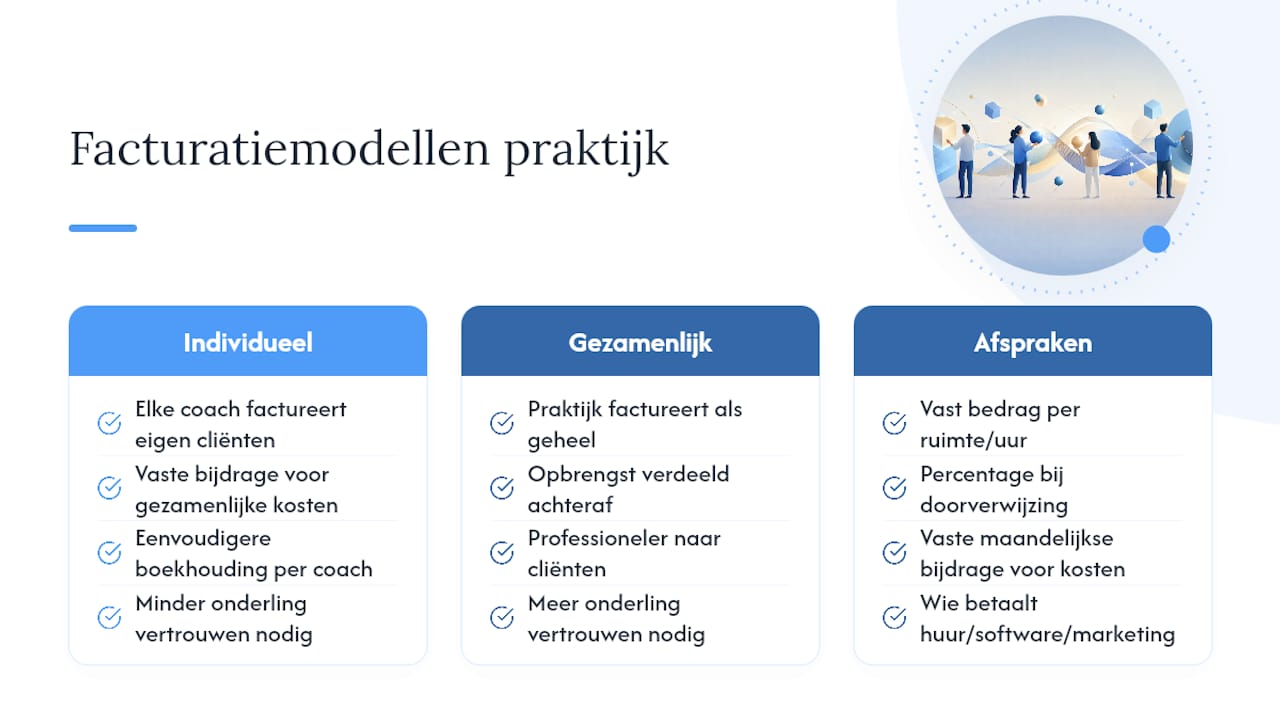
Choose a distribution rule that everyone understands without a calculation model: a fixed amount per room or hour used, a percentage for a referral, or a fixed monthly contribution for shared costs such as software and marketing.
Agree in advance who pays for the software, marketing and rent, and how you handle no-shows or cover in case of illness. Make sure financial overviews are visible to everyone. Nothing undermines trust faster than uncertainty about money.
Daily routines: planning, rooms and quality assurance
Fixed booking rules prevent double bookings: who may reserve which room when, and how far in advance. Work with block times for sessions, so the calendar remains predictable for clients and coaches.
Quality assurance requires recurring moments: periodic peer supervision, a fixed format for sessions and fixed review moments for difficult cases. Team coaching can also be useful within your own coach group: it not only strengthens teams that are stuck, but also keeps well-functioning collaborations sharp.
A simple rhythm often works best: a short weekly stand-up, a monthly quality review and a quarterly meeting in which you evaluate larger agreements.
Pro tip: Put fixed transfer points literally in the calendar, not as “we'll catch up at some point”. And use a short, fixed template for session notes. Consistency always beats improvisation.
Concrete checklist: steps for the first quarter
Setting up a multi-coach practice needn't take a year, but the first ninety days do determine the foundation. Follow this order:
- Draw up a short team charter together, covering roles, decision-making and client ownership.
- Sort out the GDPR basics: data processing agreement, retention periods and access rights.
- Record the intake and transfer procedure in one document.
- Choose a tool for client management and record-keeping, and test it during a trial period.
- Formalise the financial agreements about invoicing and distribution.
In weeks one and two you sort out the team charter and the first GDPR agreements. In weeks three to six you test the intake and transfer flow in practice and choose your tools. In months two and three you formalise the finances and refine the quality routines. Bold&Booked describes a similar build-up for a profitable coaching practice: first get things clear, then automate and scale up. Make sure access, back-up and clear client communication are properly in place from day one. That prevents most damage afterwards.
A personal note and practical experience
The most common mistake I see: coaches start working together without ever putting an agreement on paper. Everyone assumes the other thinks the same about ownership, rates or records. That rarely turns out to be the case.
A small practice I know only started making real gains once they stopped with separate Excel files and switched to one intake format and one record structure. Nothing complicated, just consistency. Work through the checklist above before you grow further.
A practical tool: when an integrated workspace helps
An integrated workspace mainly saves time at the moments where things go wrong: during intake, when transferring a client and when safeguarding your GDPR agreements. Exantur is built around precisely that process. Coaches get their own access rights, a client timeline that shows the entire history at a glance, and a secure client portal where clients can track goals and check-ins themselves.
That connects directly to the checklist above: first you choose your tool, then you test it, then you implement it in your fixed routines. Exantur offers a 14-day trial period to test whether your intake and transfer become less error-prone. Take a look at the practice management software for coaches and start the trial to see whether it suits your multi-coach practice.
Sources
- Data processing agreement | Dutch Data Protection Authority
- Not every group practice is multidisciplinary. - Conovo
- Building a Coaching Practice | Bold&Booked
- What are the benefits of team coaching and when do you use it? | Zelforganisatie Fabriek
This article contains general information and does not replace the advice of a qualified lawyer. Consult a qualified legal professional about your own situation before acting on the basis of this content.
Frequently asked questions
What exactly is a multi-coach practice?
A multi-coach practice is a collaboration in which several coaches work under one name with shared agreements about clients, records and administration, rather than each renting the same space independently of one another.
Is a data processing agreement mandatory for a multi-coach practice?
Yes, as soon as you use software or a third party that processes client data, the GDPR requires a written data processing agreement, regardless of the size of your practice.
Who owns a client in a multi-coach practice?
You determine this yourself in your collaboration agreement; usually the coach who did the intake remains primarily responsible, unless both parties explicitly agree to a transfer.
Which tool suits a multi-coach practice best?
Choose a platform with separate access rights per coach, a shared client timeline and secure record storage. Exantur is specifically built for this, with attention to GDPR-aware processing and transfers between coaches.
How do you prevent conflicts between coaches in a shared practice?
Record roles, decision-making and financial distribution in writing in advance, and agree on a fixed escalation path in case disagreements arise about clients or money.