
Milestones in coaching: how to define and measure them
Milestones in coaching: how to define and measure them

Milestones in coaching are concrete, observable moments that demonstrate a client has achieved a meaningful shift in behaviour, skill or belief. Not a vague sense of progress, but evidence you can record and revisit.
Three things you can do right away in your next session:
- Together with the client, name the evidence for the very next milestone.
- Record that evidence in your session notes, not just in your head.
- Briefly celebrate the moment, even when it's a small signal.
An example milestone you can adopt straight away: “Client gives feedback to a colleague without first apologising for the criticism.” Observable, dateable and concrete enough to put in a file.
Key insights
A milestone only works if it is observable, dated and documented, and combined process and outcome evaluation provides the most reliable picture of coaching progress.
| Point | Details |
|---|---|
| Define evidence in advance | For each milestone, record exactly what you see, hear or read as evidence, before the session begins. |
| Combine process and outcome | Use both interim observations and final measurements to assess progress reliably. |
| Limit the number of milestones | Work with three to six milestones per process to avoid fragmentation. |
| Document consistently | Record milestones in the same place and with the same language, so every file stays readable. |
| Exantur for operational safeguarding | Exantur links goals, session notes and check-ins per client, so milestones don't remain floating loose. |
Table of contents
- What is the difference between a goal, an outcome and a milestone?
- Which types of milestones do you use in practice?
- How do you define milestones with a client?
- How do you measure whether a milestone has genuinely been reached?
- Example milestones and templates you can adopt
- How do you record milestones between sessions?
- What does research say about milestones and how can you safeguard this?
- What do you do when a milestone isn't reached?
- Why milestones are more than checklists
- How does Exantur help you track milestones?
- Sources
- Frequently asked questions
What is the difference between a goal, an outcome and a milestone?
These three words are often used interchangeably in coaching processes, even though they mean different things. A goal is the end vision: where does the client want to be in six months? An outcome is the measurable result that confirms that goal, for example a higher score on a questionnaire. A milestone is the interim evidence that the client is on their way, visible well before the final outcome is there.
Choose a milestone when you want to track process, not just the outcome. A KPI tells you whether you've arrived. A milestone tells you whether you're moving in the right direction.
| Level | Goal | Milestone |
|---|---|---|
| Client | Negotiating with confidence | Making a counter-proposal in a conversation for the first time |
| Session | More self-insight | Client names a pattern themselves without prompting |
| Programme | Sustainable behavioural change after 6 months | Sustaining a new habit three weeks in a row |
This breakdown also helps with your documentation: you note a milestone differently from an end goal, and your client understands more quickly where they stand.
Which types of milestones do you use in practice?
Not every milestone is the same, and the type determines how you measure it. Four categories recur in almost every process:
- Behavioural milestones: a concrete action the client didn't do before, such as having a difficult conversation.
- Skill milestones: a demonstrable improvement in a specific skill, such as giving a presentation without a cue card.
- Emotional or relational milestones: a shift in how the client relates to themselves or others, for example less avoidance behaviour during conflict.
- Organisational milestones: in business coaching, such as a team solving a problem independently for the first time without involving the manager.
Behavioural and skill milestones work well in the short term, within two to four sessions. Emotional and organisational milestones usually require more time and multiple observation moments before you can define them with confidence.
One pitfall: setting too many milestones at once. Six separate milestones per process works better than twenty, because fragmentation makes evaluation impossible and confuses the client about where the priority lies.
How do you define milestones with a client?
A well-designed milestone doesn't start with a list, but with the conversation about change. Six steps that work in almost every process:
- Start with the vision. Ask what the client wants to see, feel or be able to do differently in six or twelve months.
- Break that goal down into three to six milestones that together form the path to that end goal, with a mix of behaviour and belief.
- Define the evidence. What exactly will you see, hear or read when this milestone has been reached? Write that acceptance criterion down literally.
- Place milestones on a timeline. Link each milestone to a session or a number of weeks, and decide when you'll schedule a check-in.
- Choose your measurement method. Is it a number on a scale, an observation during the session, or feedback from others?
- Document and plan a moment to celebrate or adjust. Put the milestone in the session file as soon as the evidence is in.
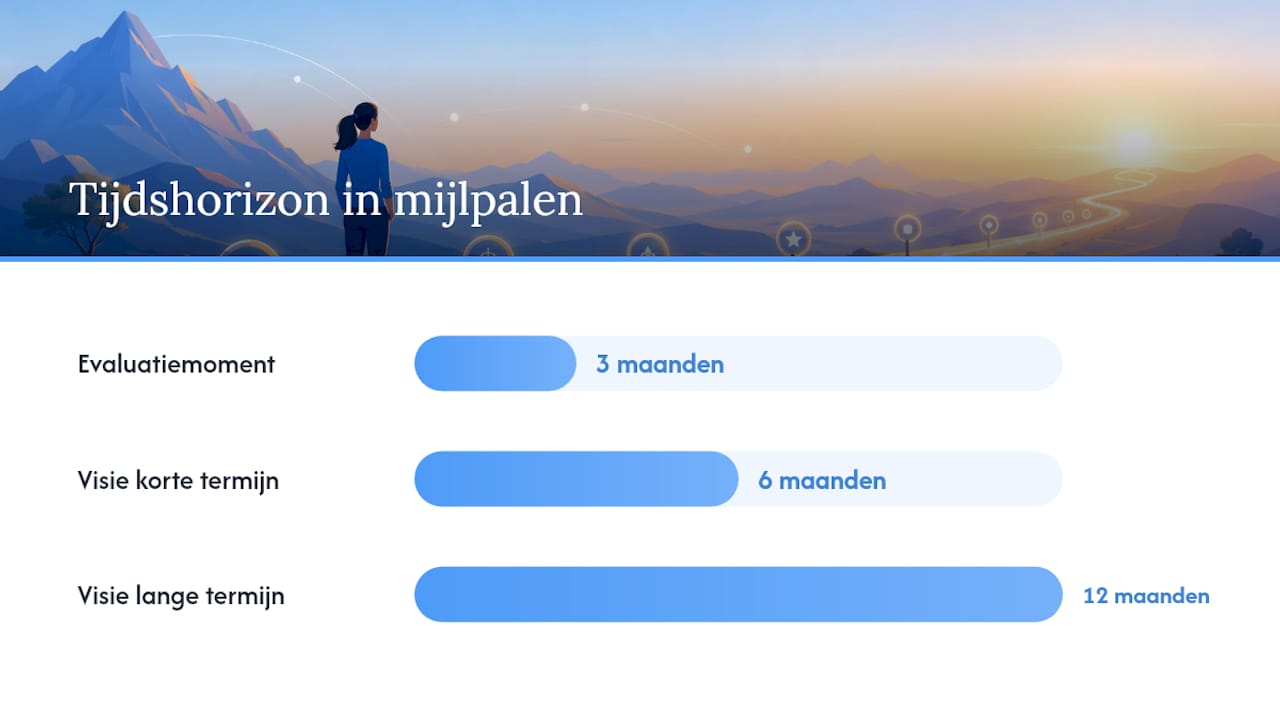
This approach aligns with a widely used model in which coaching processes go through phases such as intake, build-up, breakthrough and integration, with evaluation moments that often fall around the three-month mark. Those who divide their process into such phases in advance don't have to work out anew each time when a milestone makes sense.
Pro tip: Write the acceptance criterion in the client's own language. “I dare to say no to my manager” works better as an evidence rule than “improved assertiveness”, because your client can literally recognise it when it happens.
How do you measure whether a milestone has genuinely been reached?
Measuring in coaching revolves around two questions that are not the same. Process evaluation looks at whether the client is taking the right steps: are they showing up, practising, applying what was discussed? Outcome evaluation looks at the end result: has the behaviour genuinely changed, has the problem been solved? A review on coaching evaluation concludes that you need both to reliably assess the impact of coaching, because process without outcome says little about lasting effect, and outcome without process gives no insight into what worked.
Practical instruments you can use here:
- A short questionnaire before and after a phase of the process, to measure a shift in belief.
- Goal Attainment Scaling (GAS), where you set a scale from minus two to plus two for each goal in advance and the client scores themselves.
- Behavioural observations during the session itself, noted at the moment they occur.
- A short satisfaction question at the end of a block of sessions.
A systematic set-up with measurement before and after considerably increases the reliability of your evaluation, especially when you combine it with multiple data sources such as observations and client feedback. This doesn't have to become a heavy administrative process: one fixed question per check-in and a short note after each session is often enough. For coaches who want to improve their evaluation forms, a practical guide to coaching evaluation offers concrete examples of questionnaires.
Pro tip: Always establish your baseline measurement before the first substantive session, not after. A client who has already had one session often rates themselves more positively, which distorts your comparison.
Example milestones and templates you can adopt
Three complete examples, ready to copy into your own file:
- Business leadership: “Client delivers a critical message in a team meeting without apologising beforehand.” Evidence: team member confirms this, or client reports it themselves with a concrete example.
- Stress management: “Client recognises a tension signal within ten minutes and applies a breathing technique.” Evidence: diary note or mention during the check-in.
- Presentation skills: “Client gives a ten-minute presentation without consulting notes.” Evidence: own observation or video recording.
For each template you use the same three components: a short milestone description in one sentence, an evidence rule that states what you'll see or hear exactly, and a timeline with the scheduled check-in moment. Adapt the tone of the description to your target audience: with business clients, more formal language works, while for personal coaching the client's own choice of words works better.
How do you record milestones between sessions?
A milestone that only lives in your head disappears. Note it in your session notes or in a client portal, so you can find it again later and the client can see their own progress. Consistency in where you record this saves search time in every subsequent session.
A short check-in ritual between sessions works well: one question per week, for example “which moment this week shows you're getting closer to your milestone?” Repeat that question in the same way each time, so answers remain comparable.

A simple template for your session note: date, milestone worked on, observed evidence, and next action. For more detailed examples of such notes, you can consult a practical guide to session notes.
Pro tip: Use the same fixed words for “achieved”, “in progress” and “deferred” for every client. That way any fellow coach reading the file immediately understands where the client stands.
What does research say about milestones and how can you safeguard this?
Research into coaching evaluation confirms two things that coaches often already sense. First, process and outcome evaluation are complementary: one without the other gives an incomplete picture. Second, the relationship between coach and client turns out to be one of the strongest predictors of success.
The quality of the coach-client relationship is one of the strongest predictors of success in coaching. A milestone therefore marks not only an achieved goal, but often also a moment of deepened trust between coach and client.
That insight comes from research into how coaching influences organisational performance.
In practical terms this means you have to record milestones somewhere they won't get lost. A practice management tool such as Exantur organises goals, progress and check-ins in one place per client, linked to your session notes. Three steps to apply this yourself: record the milestones and evidence rules per client, link a check-in to each milestone, and note progress directly after the session rather than afterwards from memory.
- Document process observations per session.
- Link each milestone to at least one measurement moment.
- Keep evidence and notes together, not spread across multiple systems.
What do you do when a milestone isn't reached?
A missed milestone is not a failure, it's information. First run through a brief diagnosis:
- Was the acceptance criterion formulated clearly enough?
- Was the timeline realistic, given the client's situation?
- Were there external obstacles, such as workload or personal circumstances?
- Has the client's motivation changed since setting the milestone?
Depending on the cause, you choose an adjustment: redefine the milestone with sharper criteria, split it into two smaller steps, add extra support between sessions, or defer it temporarily. If a milestone remains unattainable after multiple attempts, that is often the signal to re-prioritise the process rather than keep pushing on the same goal.
Why milestones are more than checklists
For me, a milestone has always been more than a tick on a list. It's the moment when a client sees themselves differently for the first time, and that trust builds through the quality of the process, not just the end result.
Coaches who look only at the outcome often miss the signal that something has already shifted. A client who expresses doubt out loud for the first time without apologising may not have reached a goal, but has crossed a crucial threshold. It's precisely those kinds of moments that deserve a place in your file.
How does Exantur help you track milestones?
Exantur is built around the coaching process itself, not around general project planning. In the workspace you record goals and progress per client, link session notes to specific milestones, and let clients fill in their own check-ins between sessions via their own portal. Everything stays linked to the right process, so you don't have to search through loose documents or spreadsheets.
Choose a tool as soon as administration costs you time you'd rather spend on clients, or when you notice that acceptance criteria are being recorded differently per client. Consistency in how you document milestones makes evaluation afterwards a good deal easier, even when you're working with several clients at once.
Want to see what that looks like in practice? Take a look at the coaching programme software and start the fourteen-day trial to set up your own milestones and check-ins right away.
Sources
- Seven steps to unlocking organisational performance through coaching
- Evaluating coaching: process and outcome criteria (chapter)
Frequently asked questions
What is the difference between a goal and a milestone in coaching?
A goal describes the end vision of the process, whereas a milestone is the interim, observable evidence that the client is moving towards that goal.
What are the 7 steps of a coaching process?
A common model consists of intake, setting goals, making a plan, running sessions, interim evaluation, adjusting and closing, as described in overviews of coaching processes.
What are important milestones in achieving goals?
Important milestones are moments of visible behavioural change, such as applying new behaviour for the first time, sustaining a habit for three weeks, or feedback from others that confirms the change.
How do you evaluate whether coaching is working?
Combine process evaluation, such as observations during sessions, with outcome evaluation such as pre/post questionnaires and Goal Attainment Scaling, to gain a complete picture of progress.
How do I record milestones practically without much extra administration?
Note briefly per session what evidence you have seen and link it to the milestone in your file or in a tool such as Exantur, so you don't have to separately keep track of what is where.